Leggi questa guida in italiano
Moving day from morning to evening: who does what
Moving day happens in two homes at once: what to do before anyone arrives, who stands where, when to stop, and in what order to unload.
The boxes have been ready for days, the van is booked, and on the morning of the move you realise nobody knows where to start. The people who came to help ask you what to pick up, the driver asks you where to park, and you are still looking for your phone charger. You planned the weeks before carefully. Not the day itself, because it looked like the easy part.
Moving day has a problem the weeks before do not have: it happens in two homes at once, and you can only be in one. Split it into four stages, and for each one decide in advance who does what.
Before anyone arrives
The first hour of the day is yours. Use it to get rid of the jobs nobody will have time for later.
- Strip the bed and take it apart. It is the last piece of furniture you used, and usually the first one you miss in the evening. Sheets and pillows go in the bag that travels with you, along with what you need for the night, as covered in our guide to the first day after the move.
- Clear the way. Doors open and wedged, rugs rolled up, nothing on the floor between the bedroom and the front door. If your building asks you to protect the lift and the stairwell walls, do it now: your building's rules have an article of their own.
- Keep the space for the van. If you applied for a parking permit, check that the stretch of road is free and marked. If you did not, when you need a parking permit is explained separately.
- Buy food and drink for everyone. Water, something salty, coffee. At midday nobody will want to go out looking for it.
Two homes, two people
The rule for the day is that each of the two homes has someone who makes the decisions. If every question comes to you, you spend the day on the phone or in the car between one address and the other.
In the old home, the person who knows the boxes stays behind. They say what goes out and in what order, following the loading order: first the heavy furniture against the cab, then the long pieces at the sides and the boxes in layers, and the bed and tools last. They stay until the home is empty, and finish with the last walk round: every cupboard door opened, every drawer pulled out, photos of the meters taken.
In the new home, someone goes ahead of the van, with the keys. They open up, switch on the lights, check that the lift works and that the street door stays open. Then they put a sheet on every door with the name of the room and the same number you gave to the boxes for that room. During unloading they stand at the door and say where everything goes. They do not carry anything: whoever carries the boxes sooner or later disappears into a room, and the boxes that arrive after that all end up in the hall.
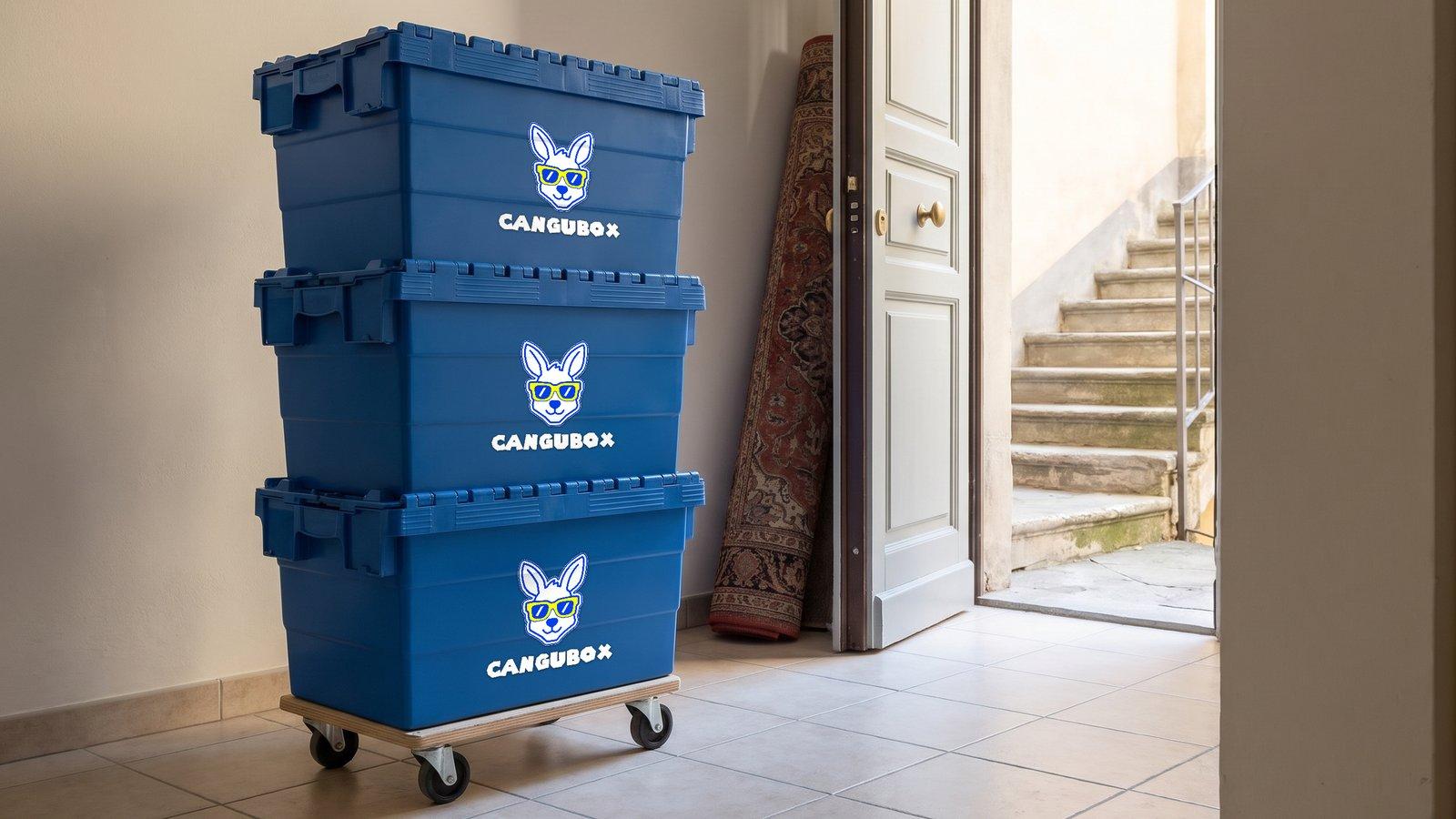
You do not write on a Cangubox with a permanent marker, so each one gets a tag with the number of its room. They are all the same size, 60 × 40 × 36 cm, and the product sheet lists them as stackable even when they are closed and loaded. On flat stretches and in the lift, from the front door to the van and from the van to the right room, the stack rides on the Dolly, the trolley that comes with every rental: you roll the whole stack instead of carrying one box at a time.
If a removal company does the transport, you still need the two people. The movers know how to load, but they do not know which room is the study. This is the middle way, where they do the carrying and you did the packing in the weeks before.
Stop halfway through the day
When the van is full, before it leaves, everyone sits down and eats. It feels like wasted time, but it is after hours on the stairs that a back gives way and a piece of furniture slips out of someone's hands. How to lift without getting hurt is covered in a separate article.
It is also the moment to check two things. That no empty space is left in the back of the van for the load to slide into, and that whoever stays in the old home knows when they can leave.
Unloading goes in reverse
At the new home the van is emptied from the doors towards the cab, so what went in last comes out first. That is on purpose: the bed and the toolbox are the first things you need. Put the bed back together straight away, before the boxes, while there is still room to move in the bedroom.
As they come out, the large pieces of furniture go straight to their places. Moving a wardrobe one metre in a full home takes more effort than putting it in the right spot now, with the room empty.
Each box goes to its own room, never piled up in the hall. In each room they are stacked against one wall, away from doors and windows, so a path stays clear. In the kitchen and the bathroom, what you need tonight goes on top of the stack.
When the van is empty, look inside all the way to the wall of the cab. Then let your helpers go before tiredness becomes a problem: opening the boxes is a job for the days after, and the evening has its own rules.
Tonight, write the day down on one sheet: who stays in the old home, who goes to the new one and at what time, when you stop to eat. Then send it to everyone who is coming to help.