Leggi questa guida in italiano
Lifting and carrying on moving day without getting hurt
What makes a load heavy besides the kilos, the reference values reported by INAIL, and how to lift a box without straining your back.
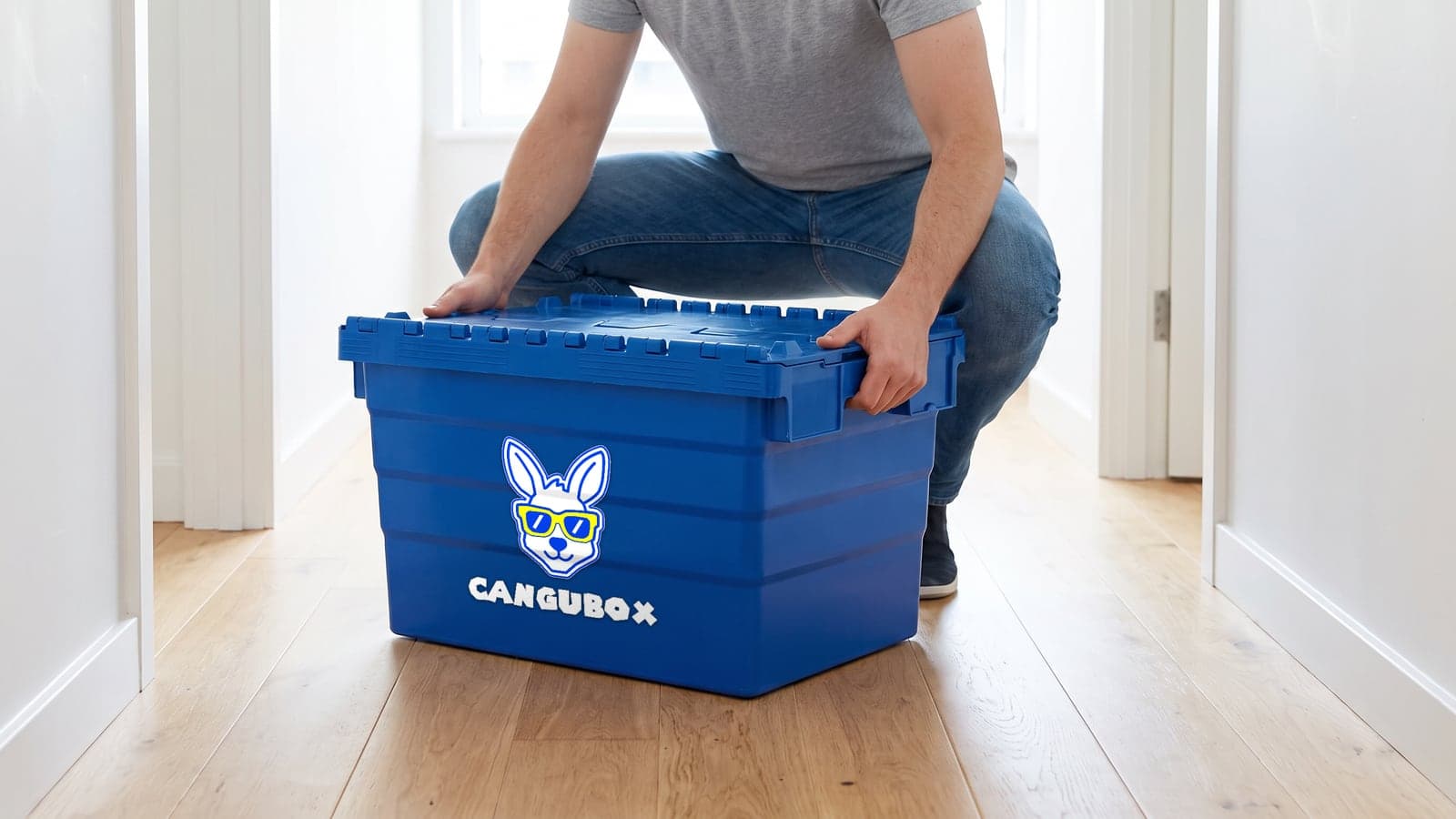
On moving day you lift dozens of boxes, one after another, and usually without ever having thought about it. Your back rarely complains at the first one. It complains at the thirtieth, or the next morning, when you are in the new home with everything still to unpack.
For people who do it as a job, manual handling of loads is a risk that must be assessed by law, and INAIL, the Italian workplace safety institute, has written clear guidance on it. It is meant for workers, but the back that lifts in a warehouse is the same back that lifts on your landing. Below is that guidance, and what it means for a move.
What makes a load heavy, besides the kilos
Weight is only one item on the list. The leaflet from INAIL's Genoa office, Movimentazione manuale dei carichi durante l'attività lavorativa (manual handling of loads at work, in Italian), lists the factors that raise the risk when you lift and carry. On moving day you meet almost all of them:
- A load that is bulky or unstable. A box with things sliding around inside it tips off balance halfway there.
- A load held away from your body, or with your trunk twisted or bent. This is what happens when the box is wide and you carry it with your arms straight out.
- Not enough free space, and uneven floors. The narrow landing, the step at the front door, the pavement.
- Too few breaks and too little recovery. The pace of someone who wants to finish before dark.
- Distances that are too long. From the fourth floor to the van parked at the end of the street.
In practice, the same box can be light in the living room and too heavy on the stairs. So plan for this too: where you will walk, how many times, and how much space there is around you.
How much you can lift: the INAIL values
The INAIL sheet Conoscere il rischio: la norma tecnica UNI ISO 11228-1 (in Italian) reports one reading of the standard, by Occhipinti and colleagues in 2010, which sets these reference weights:
- men aged 20 to 45: 25 kg;
- men under 18 or over 45: 20 kg;
- women aged 20 to 45: 20 kg;
- women under 20 or over 45: 15 kg.
These figures apply in ideal conditions and to occasional lifting, which the sheet defines as less than once every five minutes. A move is not occasional: it is dozens of lifts in a row, often on stairs, with the obstacles from the list above. So those kilos are a ceiling, and your own limit on the day is lower.
There is one thing to know about boxes here. The Cangubox has a load capacity of 30 kg, as stated by the supplier, which is above all four values on the list. The capacity tells you what the box can hold, not what you can hold. Fill it up to the weight you can lift without changing your posture, not up to the rim. With books you reach that weight long before you reach the lid, and the article on how to pack books explains how to split them up.
How to lift a box
The INAIL leaflet then gives four pieces of advice, and they are meant to be followed together:
- Keep the load close to your body. A box carried with your arms straight out is exactly one of the factors on the list above.
- Don't bend your back: bend your knees. Go down to the box with your legs, and come back up with your legs.
- Don't twist your trunk alone: turn using your legs. If you need to pass the box to someone behind you, move your feet.
- Don't lift loads that are too heavy or too bulky on your own. An awkward box is a job for two people, and nobody carries a wardrobe alone.
The sheet on the standard adds another condition: lift gradually, without sudden movements, and with a good grip. That is why it matters where you hold the box. On the Cangubox the grips sit in the two short ends, set into the plastic: one hand on each side, and the box stays in front of your stomach without you having to reach under the base.
Then there are breaks. INAIL lists a lack of them among the risk factors, so build them into the plan for the day, just like the van.
Push instead of carry
The advice the leaflet puts first is also the simplest: use the equipment you have, and use it properly. On moving day that equipment is the trolley. INAIL also counts pushing and pulling among the activities that carry a risk, and the risk depends on how often, how hard, how far, and with what kind of transport. Still, a stack pushed across a smooth floor is a single task, while carrying it by hand turns into one lift for every box.
The Dolly, the wheeled trolley, comes with every rental, whether we bring the boxes to your home or you collect them from the CanguPoint. The boxes hold a stack even when closed and full, so you build the stack once and wheel it to the lift or the van. On stairs the trolley is no use: there you carry one box at a time, and the article on a building with no lift explains how to organise it. The contents of every rental are listed in the kit.
So, before you start: count the flights of stairs, fill boxes up to the weight you can lift, put everything that can travel on wheels onto the trolley, and decide who carries the bulky things in pairs. If there is a piano in the house, if the staircase is a spiral, or if you have had back problems in the past, that is the part to hand over to a removal company: they do the transport, and you fill the boxes without rushing in the days before.