Leggi questa guida in italiano
How to load a moving van: what goes in first
A van is filled in sections, from the back towards the doors: furniture and appliances first, then boxes in layers, and last whatever you need straight away.
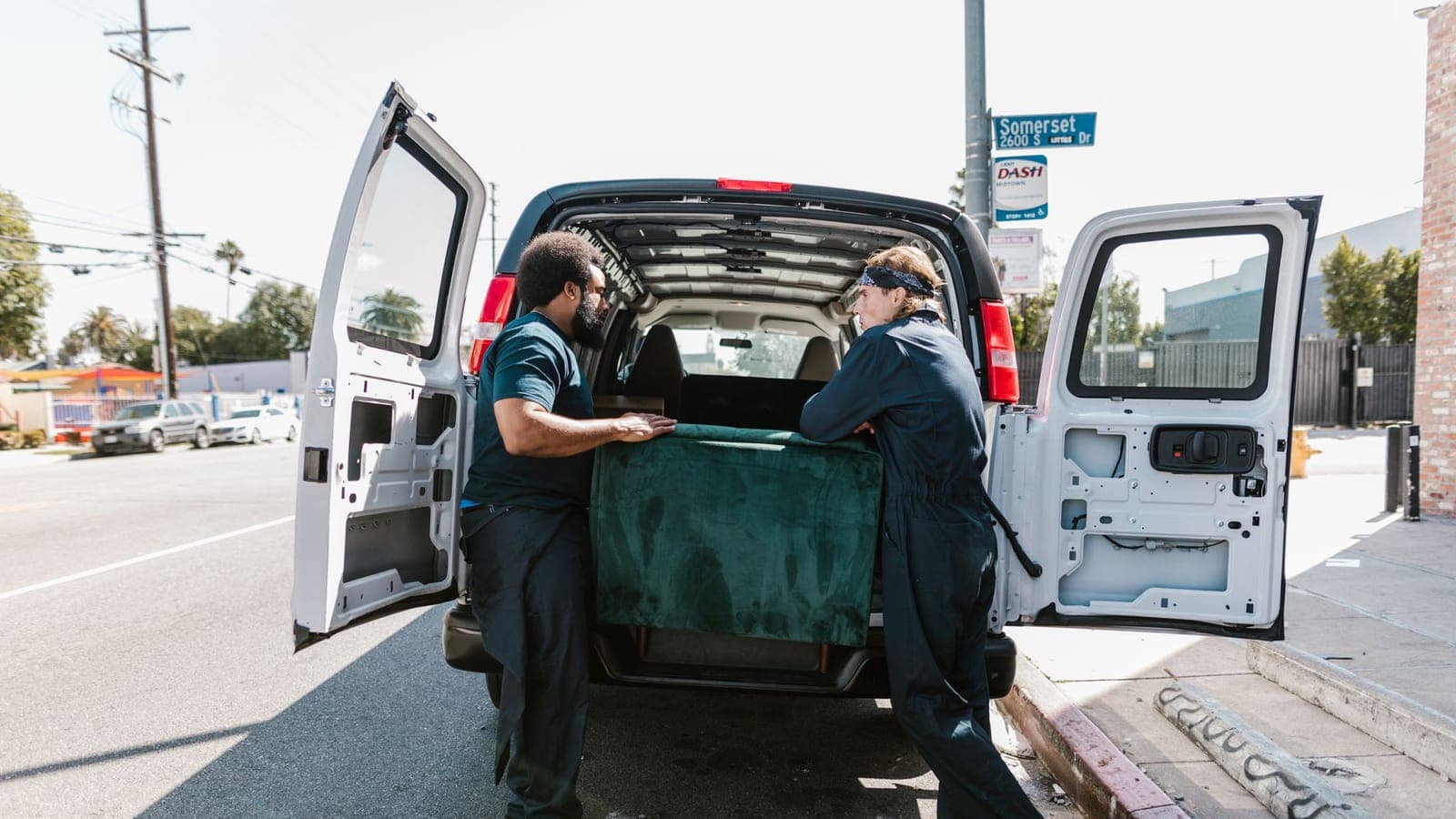
The van arrives, you open the back doors, and everyone grabs whatever is nearest the door. Usually that means the boxes, because they have been sitting ready in the hall for days. Within half an hour the floor of the van is covered in a layer of boxes up to knee height, and the fridge and the wardrobe are still on the pavement, with nowhere to go.
A van loaded in the order things come out of the house ends up badly packed. The right order has to be decided beforehand, and you decide it by starting from what has to sit at the back and what has to come off first.
Before the van: the line in the hall
The evening before, or early that morning, line things up near the door in the order they will go in. You do not need to move everything: it is enough that the big pieces are easy to reach and that the boxes are split into two groups, heavy and light.
Then take out of the line whatever is not going in the van. Documents, keys, medicines, your laptop and your phone travel with you. The first-day box is also better off in the car, if you are following the van by car. What is left is the real load, and it is worth writing it down on a sheet of paper, in order, taped to the door: the people helping read the sheet instead of asking you every time what comes next.
Load in sections, from the back towards the doors
The rule that matters is this: you do not fill the van one layer at a time across the whole floor, but in sections. You start at the wall behind the cab and build a wall of things, from floor to roof and from one side to the other. Only when that wall is full and steady do you move on to the next section, a little closer to the doors.
Within each section the order is always the same.
- Appliances and heavy furniture, first and at the back. Fridge, washing machine, sideboard, chest of drawers. They go on the floor, against the wall behind the cab, with the weight spread between left and right: a load that leans to one side is something you feel when driving, on bends and when braking. The fridge travels upright, as explained in the piece on appliances.
- Long, flat pieces, standing up along the sides. Shelves, bed bases, mattresses, the top of the dismantled table. Leaned against the side walls, they give everything else something to lean on. Mirrors and pictures have their own rules, covered in the piece on how to protect them.
- Heavy boxes low down, light ones up high. Books, tools and kitchen things on the floor; clothes, linen and toys at the top. The wall goes up straight, with no stacks standing on their own in the middle of the van.
- Gaps get filled straight away. A chair, a cushion, a soft bag: whatever space is left between a piece of furniture and a stack gets filled before you start the next section, not at the end.
A simple check before you move on: push the wall you have just built with one hand. If anything moves, fix it now, because later there will be another section in front of it and you will not be able to reach it.
The boxes: stacking versus fitting together
Above the furniture and around it, the wall is made of boxes. With boxes of different sizes, every layer has to be worked out from scratch: you find the combination that closes the row, and then you look for one all over again for the row above. And the taped lid of a box filled to the brim can bulge, so whatever you put on top of it sits off balance.
The Cangubox are all the same size, 60 × 40 × 36 cm, and the lid closes flat, in two halves that lock into each other. According to the product sheet, you can stack them even when they are closed and full. In the van this means that each layer of the wall is the same as the one below: it simply sits on top, with no fitting together. You take them as far as the back doors on the Dolly, the trolley included in every rental: the stack sits on it and you push it on wheels instead of carrying it by hand. Once there, inside the van, the boxes are lifted one at a time, like any other box. The kit lists what comes with a rental.
Last in, what you need first
The last section, the one against the doors, is the first to come off. So it holds whatever you need in the new home before everything else. The dismantled bed, with its bag of screws taped to the piece, as you do with all dismantled furniture. The toolbox. The vacuum cleaner or a broom, to give the floor a quick clean before the boxes come in. The plants, if they are not travelling by car.
This section needs securing too, and with more care than the others, because on the door side it has nothing to lean against except the doors themselves. If the van has tie-down rings, one ratchet strap pulled tight across the last wall keeps it in place. When you arrive, open the back doors slowly, with one hand on the door: the load may have shifted on the road.
If the things to load include a piano, a wardrobe that does not come apart, or a narrow staircase to tackle with something heavy, that piece is a job for professional movers. There is also the middle way: they carry the load, and you take care of the boxes.
Before van day, write the loading order down in four lines: heavy things at the back, long pieces along the sides, boxes in layers, and last the bed and the tools. Then tape it up near the door.