Leggi questa guida in italiano
How to protect paintings and mirrors during a move
Why large glass breaks on its own, how to pack canvases and frames without marking them, and which way they go in the van.
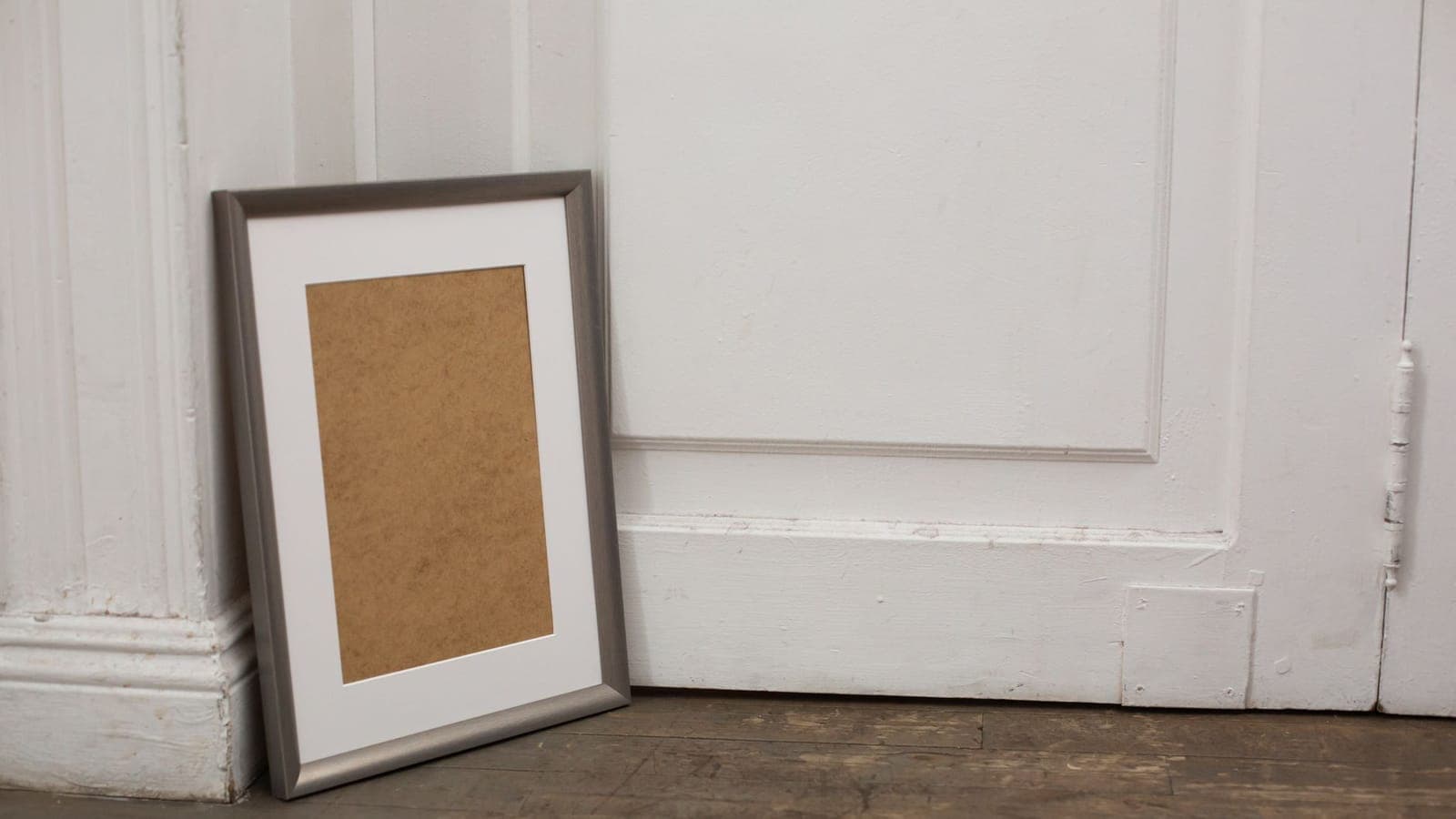
A large mirror almost never breaks because something bangs into it: far more often the cause is that you laid it flat on a shelf in the van, and at every pothole the pane flexed by a millimetre until it gave way. Thin, wide glass behaves like a plank: hold it horizontal and its own weight bends it.
From this comes the rule that applies to everything flat and fragile, frames included: it travels upright, on its edge, and never lying down. All the rest is detail, though it is enough to decide whether the picture arrives intact or in need of restoring.
Why paintings and mirrors break
There are three ways a flat object gets damaged, and they call for different remedies.
The first is bending, the one just described. It concerns glass and large canvases, and it is solved only by position: upright, resting on the long side.
The second is pressure on the corners. The corners of a frame are where all the weight ends up when you set it down, and they are also the part that sticks out most when something knocks it. After a move, more than broken glass, what you see is the corner of the frame dented or split open, with the joint come unglued.
The third is rubbing on the surface. This applies above all to paintings and to prints without glass. Here it does not even take a knock, because hours of vibration with a material pressed against the paint are enough to leave a mark, an imprint or a shiny patch where before it was matt.
Working out which of the three risks a piece runs tells you how to pack it. A wall mirror has the first and the second problem. An oil on canvas has the second and the third. A small photo in a thin frame, honestly, has only the second.
The X of masking tape: what it really does
The advice you find everywhere is to cross masking tape over the glass, in an X. It works, but not for the reason usually given.
The tape does not stop the glass breaking, because glass that flexes past its limit cracks all the same, X or no X. What it does is hold the fragments together if it happens: instead of loose shards inside the packaging, scratching the frame and cutting whoever opens the parcel, you find a cracked pane that is still in one piece. In other words it protects whoever unwraps it, more than it prevents the damage.
That said, it is still worth doing, because it takes two minutes. Two things to watch: use masking tape, the beige kind from the body shop, and not parcel tape; and you can put it on the glass, but not on the frame. Packing tape left on paint or gilding for a few days pulls the colour off when you peel it away. If the frame is antique or painted, the tape must not touch it anywhere.
How to pack a picture with glass
What matters, even more than the materials you use, is the order you put them in.
- A clean sheet on the surface. White paper, tissue paper or an old bedsheet. It stops the outer packaging printing itself onto the glass or the frame.
- The corners. They are the thing that goes most often, so they get protected separately: four pieces of cardboard folded into an L, or bubble wrap folded over several times and taped to the cardboard, not to the frame.
- Bubble wrap around it. With the bubbles facing outwards. It is a detail everyone gets wrong: bubbles in contact leave their pattern on glossy surfaces and on paint, especially if the parcel stays closed for a few days in the heat.
- Two stiff boards, one per side. These are what give rigidity and stop the bending. A panel of double-wall cardboard on each face turns the picture into a sandwich that does not bend.
- Tape around the parcel, never on the frame.
At the end, write three things on it: FRAGILE, GLASS and an arrow pointing up. Add the destination room too, so you do not open it to work out where it goes.
Paintings on canvas need the opposite
A canvas is damaged by contact far more than by weight, so the painted surface must not touch anything that can press on it. Bubble wrap laid straight onto the paint is precisely the thing to avoid: plastic does not let it breathe, it traps moisture, and with a few degrees more it can stick to the painted surface.
The correct method is to put a layer of acid-free paper between the paint and the packaging, or spacers that keep everything lifted clear. The simplest home-made way: cut four strips of cardboard and fix them to the stretcher, not to the canvas, so they stand a centimetre and a half proud of the level of the paint. Then pack: the parcel will press on the strips and not on the painting.
Never lean a canvas face-first against a wall or against another canvas. And do not poke it with your fingers from the back thinking it does not matter there: a push on the back of a canvas produces a bulge that is very visible from the front.
If the painting has a value that is not only sentimental, photograph it beforehand, with one overall shot and two or three details. It is useful for insurance, and it is also useful for spotting new damage: after a move, the memory of how it was before becomes surprisingly vague.
Mirrors, which are a problem of size
A bathroom mirror or a small framed one is treated like a picture with glass. Things change with tall mirrors, the wall-mounted ones or those fitted to wardrobe doors.
For those the most useful advice is: if it comes off, take it off. A mirror removed from the door travels upright, packed and resting where you decide. A door with the mirror glued to it travels with the wardrobe, and it is the first thing to break when the wardrobe is laid flat to get it down the stairs. If it does not come off, pad the whole face of the mirror and mark the door with coloured tape, so whoever loads knows which side the glass is on.
A large mirror is always moved by two people, and not so much for the weight, which is often manageable, as for the grip: on your own you have no choice but to hold it by the sides, which are exactly where the pane flexes. With two of you, each holds one end, upright, and neither of you should slip your fingers under the bottom edge.
How to load the vehicle
The loading rules are few, and they are all worth following.
Upright, resting against a wall of the load space, with the long side on the floor: they should not be loaded flat, nor under other stuff, nor wedged between two pieces of furniture in the hope they stay put.
Secured front and back. A parcel leaning against the side of the van shifts every time the driver brakes, and after a few kilometres it has slid diagonally with one corner acting as a pivot. Wedge in a mattress, cushions or soft bags to hold it in place.
Not resting directly against metal. Between the parcel and the wall of the vehicle there has to be something soft, because the vibrations of the panelling transfer in full.
The most precious pieces, if they are small, go in the car with you, for the same reason the good dinner service travels there too: what you cannot buy again is best kept where you can see it.
Small frames and framed photos are the one category that does well inside a box. They go on edge, in a row, with paper between one and the next, exactly like plates. A moving box takes desk frames and small pictures up to A4 without any trouble, which is the whole wall of photos nobody ever knows where to put. For those boxes the usual rule applies: whatever moves inside sooner or later breaks, so the gaps get filled. The rest, from medium-sized pictures up, does not fit and should not go in.
Heat, cold and damp
A detail that gets overlooked: works on paper and canvases suffer from sudden changes more than from knocks. A van parked in the summer sun reaches temperatures no home ever does, and an unheated garage in winter produces condensation when you bring something warm into it.
Two practical consequences. Do not leave pictures and prints in a vehicle parked in the sun longer than necessary, and do not load them first if you know the van will stay shut for hours. And if the move involves storage, ask that the pieces on paper are not left leaning against an outside wall: that is where the damp forms, and that is where the dark spots on the mount appear.
If the boxes spend a night outside, think about water too. Wet cardboard loses its stiffness, and a cardboard panel that goes limp stops doing its job at exactly the moment it is needed. A rigid Cangubox does not have this problem, and the advice not to leave a parcel where it rains still stands.
On arrival, do not just lean them against the wall
The last step is the one where more gets lost than you would think. Pictures that have reached their destination end up in a row against a wall, still packed, and they stay there for days while the house fills up. Against that row, sooner or later, someone leans a box.
If you can, unwrap them straight away and hang them, even temporarily, or put them in a room nobody walks through. If they have to wait, keep them upright with a piece of cardboard in front and a sign on top, and not against the radiator.
When you unwrap them, open the parcel flat but lift the picture upright: this is the moment when the glass, if it cracked during the journey, gives way. Hold it by the short sides, with gloves or dry hands, and check the glass against the light before hanging it. A fine crack cannot be seen head-on, whereas at an angle it shows straight away.