Leggi questa guida in italiano
How many boxes do you need for a move?
An estimate by floor area and number of people, plus the three mistakes that leave almost everyone short of boxes halfway through packing.
It is the first question anyone about to move asks, and almost everyone gets it wrong in the same direction: too low. It happens because when you look at your home you see the furniture, which does not go into boxes, while what fills them is everything else, the things you are not looking at right then: the drawers, the wardrobes, the shelves, the larder, the storage cupboard.
An estimate to start from
As an order of magnitude:
- Studio or one-bedroom flat (monolocale or bilocale): 20 boxes
- Two-bedroom flat (trilocale): 35 boxes
- Large home, three bedrooms or more: 50 boxes
These numbers are for a home lived in by one or two people, with an average amount of belongings. From there you adjust.
It helps to spell out what "average" means, because that is the part that always gets skipped: a home with no cellar, no collection of anything, where nobody works from home with papers and equipment, and where you have lived for a few years rather than fifteen. If even one of these conditions is not true for you, take the base estimate as a starting point and adjust it.
What really moves the count
How many people live there. Two people in the same two-bedroom flat have more than twice the belongings of one person: clothes, shoes and books double, and then you add the things nobody throws away because they are "the other person's".
How long you have lived there. Someone who has lived in a home for eight years has accumulated far more than someone who arrived last year, for the same floor area, because it is a slow build-up you do not notice while it is happening.
Whether you have a cellar, garage or loft. This is the most underestimated factor of all. They are the spaces nobody counts when estimating, because you do not walk through them every day, and they are also the ones holding the bulkiest things.
What kind of things you own. A home full of books fills many more boxes than a home of the same size without a bookcase. Books are heavy and take up volume: if you have a lot of them, count them separately.
Whether someone works from home. A home office does not show up in the floor area, but it exists: monitor, cables, ring binders, supplies. It weighs on the final count quite a bit.
How to count room by room
The most reliable way to get an idea is not to look at the home as a whole, but to walk through it with a sheet of paper and count the closed spaces: drawers, shelves, cupboard doors, wall shelves. Those are what end up in a box once emptied.
A rough but useful rule: one full wardrobe shelf, or one metre of loaded bookcase, is worth about one box. A large drawer of clothes, roughly the same. A drawer of cutlery and utensils is less, but it adds up with the others in the kitchen.
The walk goes like this: you go into a room, open everything, including the high cupboards you have not reached in months and the space under the bed, count the full shelves and drawers, and write the number next to the name of the room. Then you move on to the next one. At the end you add it all up and put on a safety margin of about 15%, because in every home there is a category of objects that escapes the count: shoes, cables, medicines, photos, board games.
Two warnings. The first is that what you count is not the piece of furniture but what is inside it: a six-door wardrobe is not "a wardrobe", it is six shelves plus the drawers. The second is that hanging clothes do not follow the same rule, and coats and long garments are often better moved on their hangers, inside bags, because folding them and then ironing them all again is time you do not get back.
The kitchen deserves its own count
The kitchen is the room that fills the most boxes of all in relation to its floor area. On its own it can take a quarter of the total, and the reason is that it has the highest density of objects in the home: in a few square metres there are hundreds of pieces, many of them fragile.
The point almost nobody considers is that plates and glasses carry with them, on top of their own volume, that of the padding that protects them. A dinner service for twelve, packed properly, needs far more space than it does in the sideboard. If you count the kitchen "by eye", looking at the closed cupboard doors, you get it badly wrong.
How to break it down, in practice:
- Plates and glasses go on their own, because they are heavy and need handling with care.
- Pots and pans are the lucky case: they are hollow. Fill them with tea towels, cloths and utensils and you easily save a box on the total.
- The larder: the one that fills more boxes than expected. Jars, tins, flour, spices. It pays to start months ahead, eating what you have instead of buying more, so that by the end you are moving half of it.
- Small appliances: awkward, bulky shapes. If you kept the original packaging, use it.
- The "odds and ends" drawer: every home has one and nobody can estimate it. Give it a box of its own and stop thinking about it.
Two precautions that save trouble: liquids (oil, vinegar, cleaning products) go into a sealed bag before they go into a box, because a cap that works loose in the van ruins everything else. And the kitchen gets packed last, because you use it right up to the final day: if you have not set aside the boxes you will need for it, you end up packing plates in a hurry, which is exactly when they break.
If you are moving in two stages
It happens often: you have the keys to the new home before leaving the old one, or you are waiting for some work to finish, or one of you moves first. In that case the total count does not change, but how you split it does.
The typical mistake is to divide by room: "this time I take the bedroom, next time the kitchen". It works badly, because in the meantime you have to live. The split that holds is a different one: what you will not need in the coming weeks goes straight away, what you use every day stays. The first wave takes books, out-of-season clothes, the cellar, decorations, sports equipment. The second wave is the bare minimum, which is always bulkier than you think: kitchen, bathroom, bed, work things.
In practice the first wave comes out bigger than you had imagined, while the second is still substantial, so count on a realistic split of around 60/40 and not 80/20.
If you declutter first, how much does it change
Almost always less than 20%, well below what people expect, and it is worth knowing before you rely on it too much.
The reason is that what actually gets thrown out during a move is a few very bulky pieces: a sagging sofa, a broken bike, three big boxes of stuff from the cellar, which free up space in the van without changing anything in the boxes. Clothes, books, crockery and paperwork, the things that actually fill the boxes, are far harder to throw away, because every piece needs a small decision.
That is no reason to skip it, as long as you do it beforehand, because decluttering while you pack is the thing that slows you down most: you open a box of photos, you stop for half an hour, and by evening you have packed three shelves. If you decide to lighten the load, give it separate sessions in the weeks before, and allow for the real timescales of getting rid of things: bulky waste collection has to be booked, donation points have opening hours, flea markets need you there in person.
And an honest caveat: thinning things out saves you less on boxes than it does on time and on the effort of unloading, and that is where you notice the difference.
Typical estimating mistakes, by type of home
Studio, student or first home. Always underestimated, with the phrase "but I do not have much stuff". That is true of the furniture but not of the objects, since the kitchen and bathroom of a studio contain more or less the same things as those of a two-bedroom flat.
Couple in a one-bedroom flat. The problem is duplicates. Two sets of pans, two toolkits, two shelves of books with some titles in common. If you have merged two homes, count as if you had one and a half.
Family with small children. Toys are the surprise. They are bulky, light, irregular in shape and take up far more boxes than their weight suggests. A child's bedroom can be worth as much as the main bedroom.
Home lived in for more than ten years. Here the risk is concentrated in the cellar, the loft and the paper archive. Do not estimate them without opening them: it is almost always double what you remember.
Furnished rental. The mistake is the opposite: you overestimate, because you are looking at furniture and appliances that are not yours and that you do not have to move. Count only your own things, and you will find you need much less.
The three most common mistakes
Estimating with the doors closed. The most widespread, and it applies to every type of home: you look at a room from the doorway and pull out a number, while what fills the boxes is shut inside the furniture and cannot be seen from there.
Putting off the count until you "get started". The estimate has to be done before you order, not the day you open the first box. It is the only moment when you can still adjust without it costing you anything.
Under-filling the large boxes. People who worry about weight fill them halfway, and end up using twice as many. Books and heavy things go at the bottom, the rest on top: a full box is more stable than a half-empty one, which caves in when you stack it.
Better too many than too few, within reason
When in doubt, the next size up is always the better choice. Running out of boxes halfway through packing means stopping, going out, and buying cardboard in a rush the day before the move, which is when it costs the most, in money and in nerves.
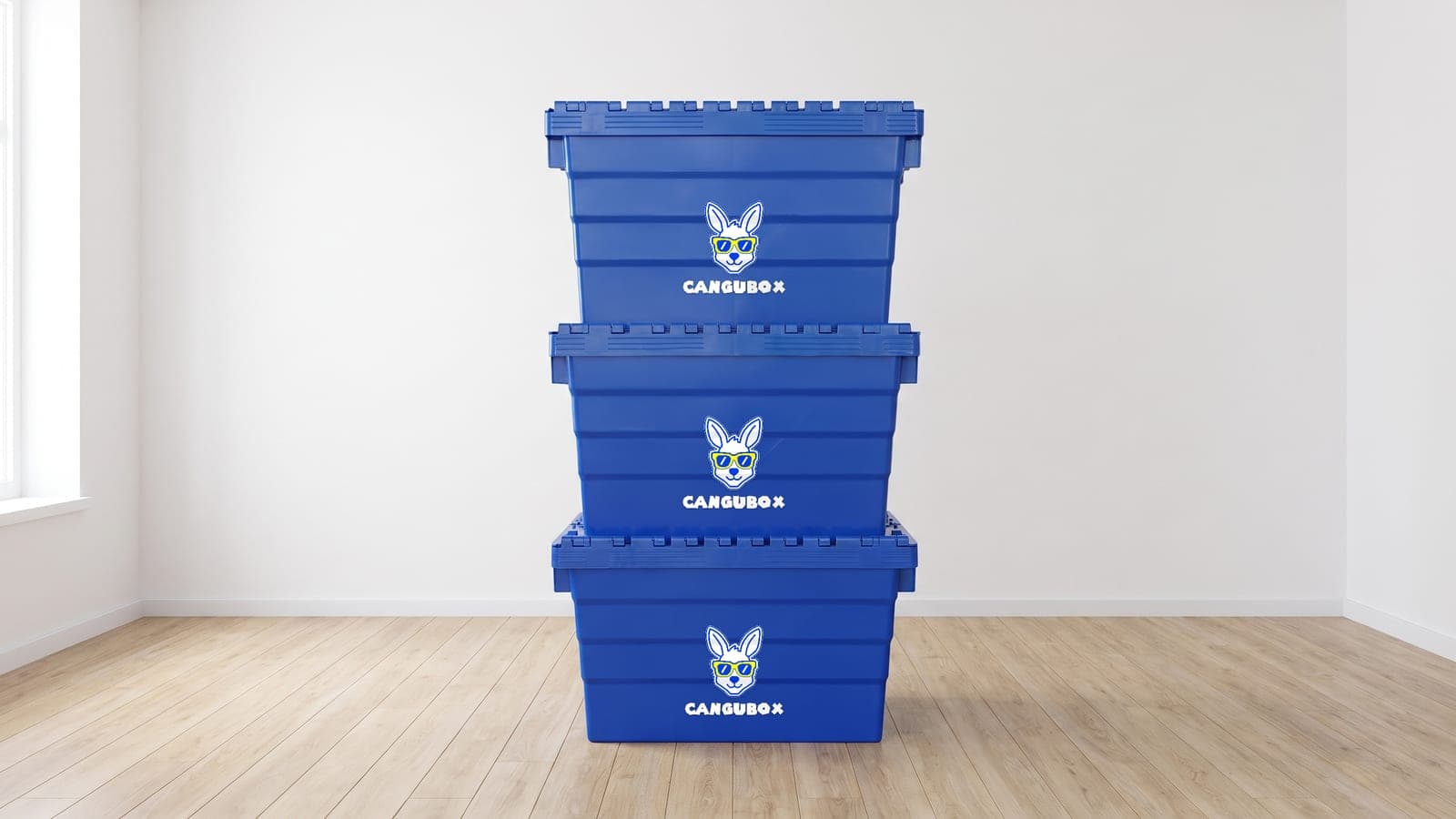
With rental this reasoning is simpler than with buying: one extra box returned empty is not a problem, while a cardboard box bought and never used just sits there. Cangubox are rigid and designed to be used and reused for a long time, so keeping a safety margin does not mean throwing material away, only leaving a bit of capacity unused.
The only case where overdoing it is a nuisance is space at home. Empty boxes waiting to be filled take up a corridor, and if you take far more than you need you live with them for a few weeks. The right margin is the one that covers you against surprises without turning your living room into a warehouse.
If you do not want to do the sums by hand
On the site you will find a configurator that, with four questions (how big your home is, how many people are moving, how much stuff you have, whether there is a cellar too), tells you how many to start from. It does not claim to be a precise measurement, it is there to take the question off your mind.
If you would rather look straight at the available combinations, the kits are here. And if you are between two sizes, the advice is the same as before: take the larger one.