Leggi questa guida in italiano
How to pack dishes without breaking a single one
Why plates go in on their edge, the method step by step, the rule of weight at the bottom and the mistakes you pay for when unloading.
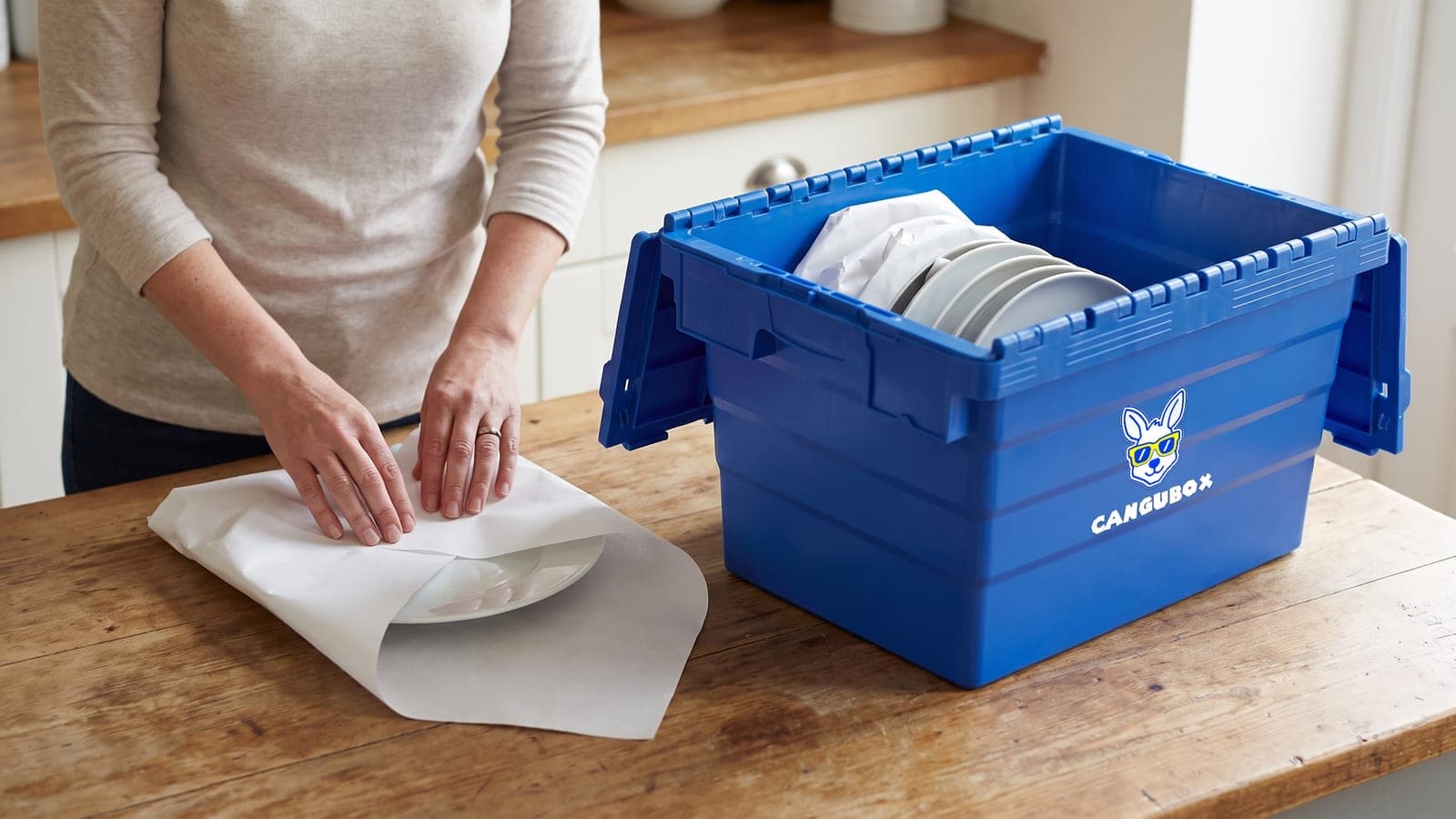
Plates are the thing that breaks most often in a move, and almost never from a knock: in most cases it happens because they were packed the way they sit in the cupboard, one on top of the other, flat. In that position the whole weight of the stack bears down on the plate at the bottom, and one pothole is enough to crack it.
The good news is that you need no special materials and no particular skill. Two or three precautions are enough, understood once and then repeated the same way every time.
The right position inside the box
Plates go in vertically, on their edge, like records in a crate or files in a filing cabinet. In this position each plate bears its weight on its own rim, which is the thickest and strongest part, and not on the whole surface of the plate underneath.
The reason is mechanical: a plate is a thin disc, and laid flat with weight on top it works in bending, while ceramic has almost no resistance to bending. An uneven support point underneath, a fold of cardboard or a knot of paper, is all it takes for the crack to start there. On edge, by contrast, the load runs along the rim, where the material is solid, and the vibrations of the journey spread out without concentrating in a single point.
There is one exception: very wide serving plates, trays and cake stands. On edge they are unstable and tend to lie down during the journey, which is the worst position of all. Put them upright all the same, but leaning against the long side of the box, and wedge them with something soft on the left and on the right.
The method, step by step
- Prepare the bottom. A layer of bubble wrap or crumpled paper on the bottom of the box: it absorbs the knocks from below, the ones you get every time you set the box down on the floor. Make it a couple of fingers thick and pressed down: paper that is too puffed up compresses during the journey and leaves you the gaps you wanted to avoid.
- Wrap the plates one by one. One sheet per plate, folded shut underneath. If you are short of material, alternate: a sheet between one plate and the next is already much better than nothing, because what breaks them is not the contact itself but the constant rubbing between two hard surfaces.
- Put them in on edge, in a row. They go one alongside the other, so that no plate rests on another. If the box is wide, make two parallel rows and keep the biggest plates towards the outside.
- Fill the gaps. The space left at the sides has to be filled with paper, cloths or tea towels. Whatever moves inside the box sooner or later breaks: if you shake the box and feel something shift, you are not done.
- Light things go on top. Glasses, cups and anything that weighs little, never a second layer of plates.
A box of crockery gets heavy long before it looks full. The test is simple: lift it off the floor. If you have to change grip halfway through the movement, or if you feel like resting it on your knee, take something out, because it only takes one box slipping out of your hands to break twelve plates in one go.
Weight goes at the bottom, always
This is not just for plates: inside every box the heavy things go at the bottom and the light ones on top. And between boxes the same applies when you stack them: the heavy ones at the base of the pile.
A mistake you see often is the box of books put on top of the box of glasses, because it was the one in hand at the time, and you find out the result when you unload. If the boxes are not all the same size the rule matters even more, because a small box resting on a large one puts all its weight on two edges instead of four.
Cups and glasses
Put glasses in standing up, not lying down, each one wrapped separately and with paper tucked inside. The paper inside is not filler: it stops the walls being crushed inwards when the glass takes a push from the side.
Cups can be nested one inside the other only if you put a sheet in between: handles are the part that comes off first, and two handles touching for the whole journey chip each other. If you stack them, turn them so the handles are staggered.
Glass and crystal
Thin glass breaks from vibration more than from weight, and that changes how you pack it: where plates are at risk from the load, stemmed glasses are at risk from the constant shaking of the vehicle, which works for the whole journey on the weakest point, the join between stem and bowl.
So: every stemmed glass wrapped separately, paper inside the bowl, and standing up. Never lying down, because in that position the stem becomes a lever and it takes very little to snap it. They go in the top layer of the box, and nothing goes on top of them, not even something light.
If you have flutes or long-stemmed glasses, consider giving them a small box of their own, filled to the top with soft material: it is the one case where it is worth wasting volume on purpose.
Crystal deserves extra care: it is harder than ordinary glass, and that also makes it less tolerant of sharp knocks. Do not use newspaper in direct contact: the ink transfers, and on a piece that stays wrapped for days it becomes a job for detergent. Better white paper or a clean tea towel.
The good dinner service
The service for special occasions poses a different problem from everyday plates: if it breaks you cannot buy it again, because that pattern is no longer made or because it belonged to someone who is no longer here.
Three things that really help. Photograph it before packing, piece by piece: if something arrives broken and you have to take it up with an insurer or a removal company, that photo is worth more than any description. Do not mix it with the everyday crockery: give it a box to itself, packed calmly and not on the last evening. And if it has gilding or raised decoration, keep a sheet between one piece and the next afterwards too, when you put it away in the new cupboard, because what wears gilding away is constant rubbing, more than any knock.
Then there is a choice worth considering, and it is not out of distrust of whoever is doing the transport: keep the good service in your own car. It is the one box you would not want to reopen holding your breath, and it fits in a car.
Pots, lids and pans
Pots look like the easy part of the job, and mostly they are: they are metal and they do not break. There are two other problems: glass lids and space.
Glass lids break far more often than the pots they cover. Always take them off, wrap them as you would a plate and put them in on edge, with the plates or in a row of their own. If the knob unscrews, remove it and put it in a small bag taped to the lid itself: it is the piece that gets lost most easily, and without the knob the lid is useless.
For space, the opposite of the plate rule applies: pots nest one inside the other, and it is the one case where stacking is the right choice. Put a cloth between each one, to avoid scratches on the base. Inside the biggest pot go ladles, oven gloves and all the small clutter of the kitchen drawers, so it travels protected and does not take up a box of its own.
Non-stick pans are the exception: never stack them without something in between and do not put anything heavy on top of them, because the coating gets damaged by contact and by pressure and a scratch cannot be repaired.
What you already have at home
You need less material than it seems. Some bubble wrap for the really delicate pieces, and for everything else what you already have: cloths, tea towels, bath towels, jumpers, sheets, socks pushed inside the glasses. They take up space you would have to fill anyway, so they do double duty at no cost, and you neither have to buy them nor get rid of them afterwards.
A few warnings, because not everything works equally well. Newspaper stains: on glazed ceramic it washes off, while on crystal and pale porcelain it leaves marks, so keep it for filling gaps rather than putting it against the pieces. The clothes you need in the first week are not packing material: they end up at the bottom of the wrong box and you do not see them again for days. Loose polystyrene, the packing peanuts, fills worse than paper: it compacts and migrates downwards, leaving air exactly where support was needed.
A rigid box does not split at the bottom and does not soak up water the way cardboard does, so it removes one problem from the start. The padding is needed just the same, though: plates break from the vibrations of the journey, not because the container gives way. Pack as you would inside a cardboard box. It is one of the reasons plastic Cangubox work well in the kitchen, which is the room where cardboard suffers most.
One last thing: write on it
Write FRAGILE and the destination room on the side, not on the lid: when the boxes are stacked, you cannot see the lid. And write it on two different sides, so you can read it from wherever you are standing.
Add an arrow pointing up, and if you have two minutes a line about what is inside. "Dinner plates and soup bowls" is a piece of information that saves you half an hour of opening boxes at random when you unload.
How to load the vehicle
Good packing can be undone in ten minutes of bad loading. Boxes of crockery are loaded last and unloaded first, and they stay high up: never under other boxes, never under a piece of furniture, never under a toolbox put down there "just for a second".
Put them towards the cab, where the vibrations are smaller, and resting against something that holds them still. During the journey it is the braking that does the damage, more than the potholes: an unsecured pile moves forward at every stop, so much so that after twenty kilometres what you stacked straight has become a leaning heap.
If there is empty space left in the vehicle, fill it with bags of clothes, cushions or duvets instead of leaving it free. A compact load moves far less than a tidy load full of air.
How to unload and unpack without breaking anything
When unloading, the classic mistake is to set the box down on the floor with a bump. The bottom is exactly where the plates touch, and a hard landing on a hard floor delivers the knock right there. Set it down tilted, first on one edge, then let it go: it is a movement you learn in two tries and it is worth all the bubble wrap you put underneath.
Then unpack from the top, always, and in order. The temptation is to pull out the first plate you see or to tip the box out onto the table: but plates on edge hold each other up, and as soon as you take one out from the middle of the row the others tilt and end up touching with no paper between them any more. Start from one end and work along.
Empty one box at a time and finish it before opening the next. Three half-open boxes in a small kitchen are the most reliable way of knocking something over while you look for something else.
Unwrap each piece as you take it out, before you set it down anywhere. A plate still wrapped and placed on the worktop slides, because paper and bubble wrap have no grip, and two or three balanced like that are enough for one to end up on the floor at the end of the day, when you are tired and have already decided the hard part was over.