Leggi questa guida in italiano
What to do with the things you are not taking with you
How to decide what does not come with you, where each category should end up and how far ahead to start, since the decision slows you down more than the effort.
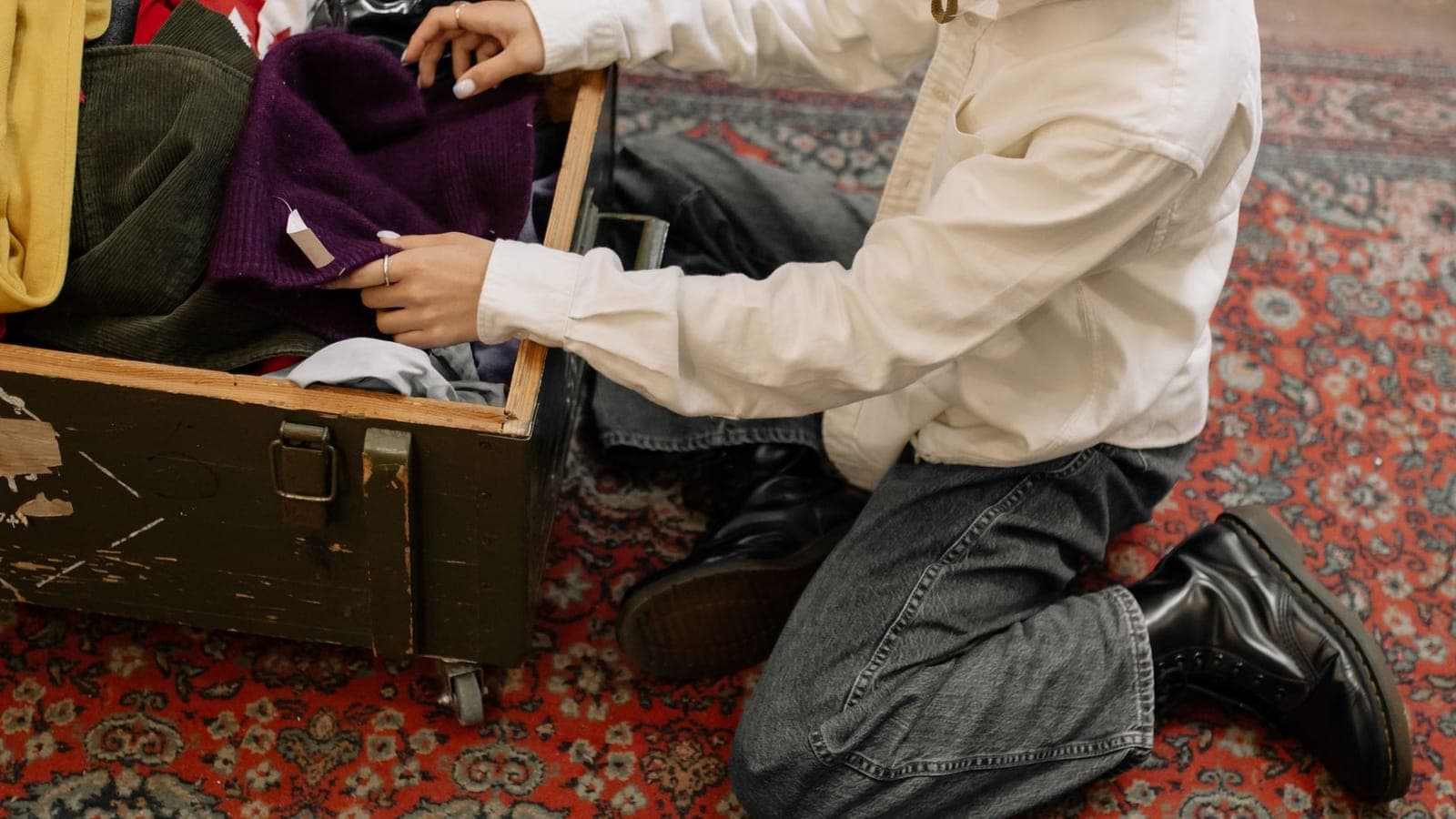
You open the first wardrobe meaning to fill a box and you stop after ten minutes. Not because folding jumpers is hard, but because the third jumper is the one you have not worn for four winters, and now you are deciding whether to keep it instead of packing. Then it happens again with the shoes, with the cables in the kitchen drawer, with the books you have already read. By the end of the day you have put very little away and you are tired anyway.
What slows a move down is the decision more than the effort, and the worst moment to make it is with an open box in front of you and a van booked for Saturday.
A move is the deadline you never had
The things you no longer want to carry did not appear the day you signed the new contract. They have been there for years, and until now nobody has asked you to look at them: in a home you live in there is always a third option, which is to leave everything where it is.
A move takes that third option away. Every object has to end up in a box or stay behind, and that turns the move into the moment the decision gets made whether you like it or not. It is uncomfortable, and it is also the one good thing about it, because sorting now is not extra work added to the move: an object you decide about today saves you four jobs, since you do not pack it, do not load it, do not unload it and do not find a place for it in the new home.
It is worth writing down as an order of magnitude: the time you spend sorting comes back multiplied, while the time you do not spend on it turns up all at once, in a room full of boxes nobody feels like opening.
Decide the rule before you open the wardrobes
People who get stuck in front of a wardrobe are not being lazy: they treat every object as a new case and rebuild the same reasoning eighty times in an afternoon. A rule decided once, by contrast, covers everything you open afterwards.
Four questions, always the same ones, always in this order:
- How long since I used it? If a whole season has gone by without you using it, you have a fact and not an impression. The coat you did not wear last winter, the racket untouched for two summers, the pan at the back of the cupboard because you never reach that far.
- If it vanished tonight, would I buy it again? This is the question that unlocks the hard cases, because it moves you from "I would hate to throw it out" to "how much do I need it". Plenty of the things you would never throw away are ones you would not buy again if they vanished.
- Does it have somewhere to go in the new home? Take the measurements instead of trusting your memory, because if the new place has fewer wardrobes or fewer square metres than the old one, sorting becomes a matter of arithmetic more than of virtue.
- Am I keeping the object or the memory? If it is the memory, a photograph often does the same job and takes up nothing. That goes for children's drawings, for tickets, for the T-shirt from a concert twenty years ago.
Then there is the "maybe" pile, and it is worth naming straight away, because that is the one that survives moves: putting something in the maybe pile does not answer the question, it only postpones it in tidier clothes. The only way to stop it growing is to give it a date, and we get to that shortly.
Every destination needs its own notice
Once you have decided something is not coming with you, it is not over: it has to go somewhere, and each route takes its own time. This is the part that wrecks the last few weeks, because it looks instant and it is not.
- Selling. Photos, listing, messages, appointments, people who do not turn up: put together, that is weeks of work, not days. Set a stop date: anything unsold by that day changes destination and does not wait for the right buyer.
- Passing it on to someone you know. It closes sooner than a sale, but it depends on when that person can come and get it. Ask for a precise date rather than for general availability.
- Donating. Check first what the recipient accepts, in what condition and at what times. Some charities collect from your door and have weeks of waiting, others take only certain categories. One phone call first saves the trip with a full car and a closed door.
- Bulky waste collection (ritiro ingombranti). A sofa or a mattress does not go in a street bin. Your local council website tells you whether the service exists, how to book it and how much notice it wants: look now, because the notice period is the part that always catches people out.
- The local recycling centre (isola ecologica). Opening times, what it accepts from private residents, whether you need a document or a card. These things change from council to council and change over the summer, so the council page is worth more than what you remember from last time.
A note about heavy things, because this is where doing it yourself ends sooner than people expect. A sofa has to be carried down, and if you live on the fourth floor with no lift, or the stairs turn in a tight spiral, or your back has given you trouble before, that is the call to a removal company or to a house clearance firm. It is not giving up, because it is the same reason a piano gets handed to people who do it for a living.
Then take the date of the move and count backwards, giving each destination its own week. If you do not have a calendar yet, a checklist with the weeks laid out is the place to slot these lines into.
What the way you pack changes
Up to here the sorting is yours and has to be done anyway. The way you pack decides one thing only, and that is how long you can postpone the "maybe" pile.
With Cangubox you choose the length when you book, and that date works for you, because it is the day by which the "maybe" has to have found a destination. If you need more time, you can ask us for an extension.
There is also the count of operations, and this is where sorting done early shows up in full. A cardboard box bought for things you then throw out still has to be assembled, taped, filled, carried by hand, emptied and disposed of: counting the purchase, that is seven steps for contents that never wanted to reach the new home. Sort before you order and you simply order fewer boxes. How many you need is counted on the enclosed spaces still full after the sorting, not on the ones full today, and the kit is chosen on the home page. If you overestimate, you return the Cangubox you do not use along with the others, with no extra work for you.
We deliver and collect in Milan, the covered postcodes of its hinterland and the province of Monza and Brianza: the postcode check on the home page tells you in a second whether your address is inside.
Start with the room you care about least
Almost everyone's first mistake is opening the box of photographs. It is the wrong room to start from: every object there is a story, you go on for three hours and decide nothing.
Start instead with the storage cupboard, the cellar, the bathroom cabinet, the drawer full of cables. Those are places where the questions have quick answers and where the largest volume in the house sits. An hour in the storage cupboard clears more than an afternoon of albums.
Then three practical rules, and they are short on purpose:
- One hour, one enclosed space. A shelf, a drawer, a cupboard door. When that is done, the session is over. A short session is one you repeat, while nobody starts a marathon again.
- Every destination gets its own date in the calendar. The sold, the donated, the bulky waste, the recycling centre. A destination you have not given a date to stays a pile in the hallway.
- The "maybe" expires. Pick a day, write it down, and on that day everything still in the maybe pile gets decided standing up, without being put back. You will decide worse than you would have with time to spare, but still better than what happens if you do not decide at all.
When you reach moving day with the sorting already done, packing becomes what you wanted it to be all along: a dull, predictable job where you open a cupboard and put in what is there, because the hard part was closed weeks earlier.