Leggi questa guida in italiano
How to pack books without making the boxes impossible to lift
Books are heavier than they look: small boxes, spine down and boxes filled only halfway are how you move them without damaging them or hurting yourself.
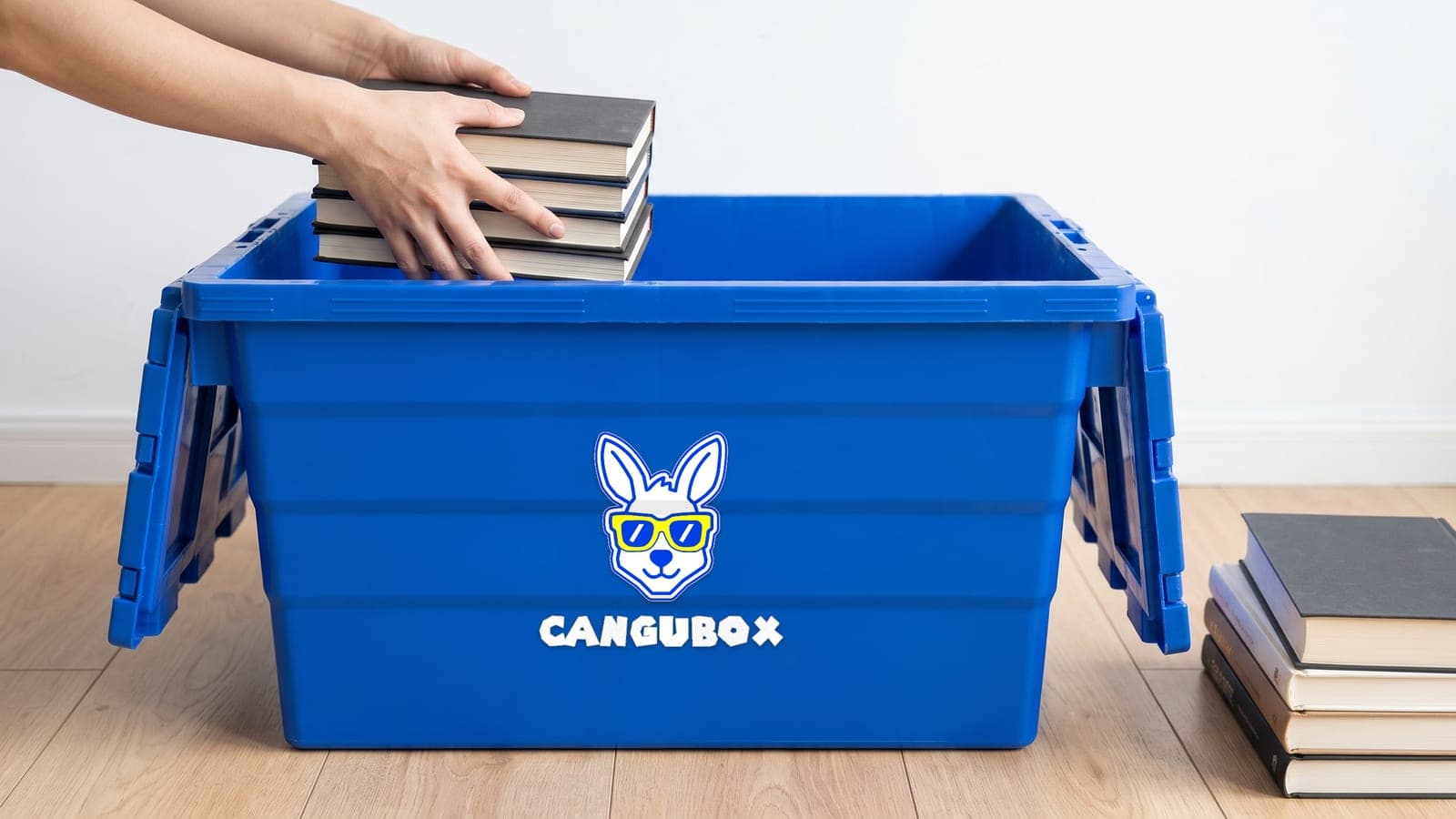
Books are the one thing in the house that can make a perfectly sound box impossible. The cardboard holds, the tape does too, and the contents are not even fragile: and yet that box will not come off the floor, and once you do get it up, it becomes the worst thing to carry down the stairs.
The reason is a matter of arithmetic: a paperback weighs between 200 and 300 grams, an illustrated hardback easily goes over a kilo, and books packed into a box leave almost no air. Every extra centimetre of volume becomes real weight, whereas with clothes or pans the volume fills up with nothing, which is why a box of books almost always weighs more than the person lifting it expects.
Why a smaller box is better
If you can choose the size, books go in the smallest boxes you have. With a small box it is hard to go over a weight you can manage, and that is where the whole advantage lies, not in protecting the books.
The sum is quick: a box of 60 × 40 × 36 centimetres on the outside, which is the size of ours, holds 68 usable litres. Filled with nothing but books it would go well past the 30 kilos a Cangubox can take, and before the container there is the real limit: what you can take, up a flight of stairs, on the fifth box, with sweaty hands.
So the practical rule: large boxes get filled with books only halfway. On top goes something light and bulky, cushions, duvets, bags of clothes, which also wedges the books in place and stops them shifting during the journey. You lose volume, but in exchange you get a box you can carry with two hands without thinking about it.
If you want a threshold: twenty kilos is the point beyond which a box stops being comfortable for anyone, and fifteen is the right weight if you have to do a lot of them one after another. There is no need to weigh them, since lifting the box ten centimetres off the floor is enough: if to do that you have to arch your back or change grip halfway, take three books out.
How to put them in
There are two good positions and one that ruins books.
Flat, stacked. Cover against cover, in low piles, filling one layer before starting another. It is the safest way for heavy volumes and hardbacks, because the weight spreads over the whole surface of the cover.
Upright, with the spine resting on the bottom. The way they stand on a bookshelf, but lying on their backs. It works well for paperbacks and saves space, because the books hold each other up.
Never spine up. This is the one that does damage. If you rest a book on its fore-edge, that is on the open side of the pages, the whole weight of the text block pulls downwards while the cover stays put. On a long journey, or in a box that stays closed for a few weeks, the binding loosens and the spine bows. Nothing breaks, but the book no longer closes properly and there is no way of putting it back as it was.
The biggest and heaviest books go at the bottom, paperbacks on top. That holds inside a single box and between boxes too, when you stack them.
Gaps and damp
The space left over has to be filled, as with anything else. A book that slides back and forth inside the box bangs its corners, and the corners of the covers are the first part to wear. Crumpled paper or a tea towel tucked in at the side is enough.
Damp is the least considered risk and the most expensive. Paper absorbs water from the air and holds on to it, and a box of books left for two days in a garage or a cellar picks up a musty smell that then lingers for months. If rain is forecast for moving day, or if the boxes have to wait in a lock-up garage, keep three things in mind:
- cardboard resting on a concrete floor draws up moisture by capillary action: put a pallet, a board or even just a couple of battens under the pile;
- a cardboard box with a wet bottom gives way without warning, and it gives way while you are lifting it;
- rigid plastic boxes absorb nothing, and for books this is the real advantage, more than sturdiness.
If the boxes are going into storage for a few weeks, do not seal them airtight with the damp already inside. Pack the boxes in a dry room and close them there.
The books you care about
For old editions, signed books or those with the original dust jacket, two extra precautions apply.
Take the dust jackets off and lay them flat, all of them together, inside a folder or between two pieces of card. It is the part that tears first and the one that counts most in the value of an edition.
Do not use adhesive tape in contact with paper, ever, not even to hold shut a volume that falls open on its own. Tape leaves a mark that turns brown over the years and does not come off. If an old book needs to be kept shut, tie it with a wide cloth ribbon, not with an elastic band, which marks the cover.
For leather-bound volumes, a sheet of white paper between one and the next: leather transfers and gets scratched against printed paper. And no newspaper in contact with any valuable book, for the same reason you do not use it with pale porcelain.
Before you pack: thin them out
Books are the category where the move does the selecting for you, if you let it. Taking a book from one home to another costs effort and space at two different moments: when you load it and when you have to find it a place on the new shelf.
A test that works better than "I like this one": pick the book up and ask yourself if you would open it again or lend it to someone. Outdated technical manuals, ten-year-old travel guides and duplicates rarely pass this test, and carrying them costs the same effort as all the others. Local libraries, second-hand markets and the swap groups in your area almost always take them, and it takes less time than carrying them would cost.
One warning, because the advice has a flip side: do not thin out the night before. In a hurry you throw out badly, and books are the thing people regret most often. If you have no time to decide, pack everything and postpone: one extra box does not ruin a move.
Label with the unloading in mind
On a box of books the label is less about protecting them and more about not ending up with twelve identical boxes in the middle of the living room.
Write HEAVY as well as the room. It really matters, because whoever helps you unload decides how to lift based on what they read on the box, and a heavy box tackled as if it were light is the classic way to hurt your back.
Before emptying the bookcase, take a photo of it. If you have an order of your own, by author or by subject, the photo saves you an afternoon of rearranging. And number the boxes following the shelves: 1 is the first shelf, top left, and so on. When unloading, open them in order and the books go back to their places on their own.
Carrying them without hurting yourself
Boxes of books are loaded low in the vehicle and kept against the sides. They are the ones that have to be at the bottom, never on top of the crockery, never at the top of a pile that someone then has to take down while balancing.
When carrying them, what matters is how you lift: bending your knees and keeping the box close to your body, not at arm's length. The two-wheeled sack trolley, if you can borrow one, is the tool that makes the biggest difference to the day, and for books it counts more than for anything else.
Then there is a trick that really works, and it is the one occasion when a suitcase beats a box: the wheeled travel kind. A hard-shell suitcase full of books can be pulled with two fingers, goes down the stairs on its side and does not burst. Fill it two thirds full and no more, because the telescopic handle was not made for forty-five kilos and it bends.
In the new home
Assemble the bookcase and anchor it to the wall before opening a single box. Almost nobody does it, because the urge to start unpacking is stronger. The result is a wall of book piles on the floor that you have to move twice, and a tall bookcase loaded before being fixed to the wall is dangerous, especially if there are children in the house.
Then fill it from the bottom up and from the centre outwards. Shelves loaded at the ends first warp more, and on a long shelf the difference is visible to the eye after a few months.
Rigid boxes like the Cangubox have an advantage at the tail end of the move that you notice with books: you empty them, stack them and hand them back.