Leggi questa guida in italiano
How to pack clothes without ironing everything again
Why creases set while the box sits still, which garments hang and which get rolled, and what to do in the first two hours after you arrive.
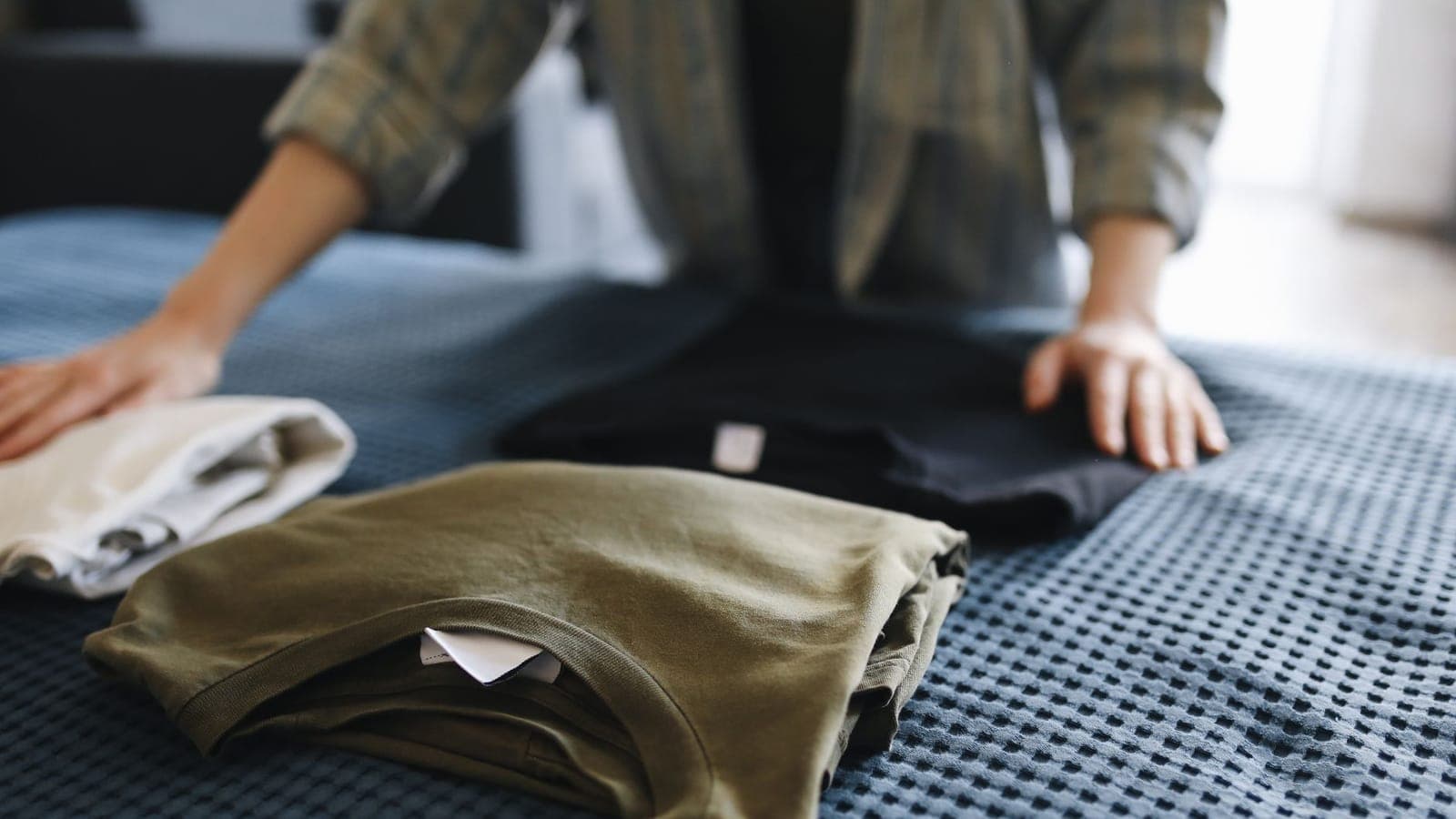
You spent an evening ironing your shirts, folded them carefully and put them at the bottom of a box. Four days later you take them out and they look like they came from the laundry basket. The journey has little to do with it: they got that way while the box sat still, closed, with two more resting on top of it.
Creases do not come from the bumps but from weight that lasts over time, and they are the most predictable thing in a move, because they depend on three factors you know in advance: how hard you press, for how many days, and how much moisture is in the fabric. If you keep those three under control, at the other end you have two garments to iron instead of twenty.
Why creases set during the journey
A fibre bends and springs back: that is what it does every day when you sit down. It turns into a permanent crease when it stays bent for a long time under steady pressure, and even more so if there is moisture while it happens.
Cotton and linen are the worst, because their fibres hold water and take on whatever shape they are in while they dry. It is the same mechanism as an iron, which uses steam and pressure to set a crease you want, and inside a box the same thing happens without anyone deciding where the crease ends up.
Wool behaves the other way round. It holds creases poorly, but a jumper left on a hanger for a week stretches at the shoulders, while the same jumper folded flat comes out unmarked. Synthetics sit in between: they crease very little, and if they stay compressed in the heat they take on a shine that never comes out.
The practical rule follows from this: silk and cotton shirts suffer from time spent under weight, while for jumpers the problem is the hanger and for technical fabrics it is heat, since a van parked in the August sun reaches temperatures a house never gets to.
Three groups of clothes, three ways of travelling
Before you touch a box, split the wardrobe into three piles, not by type of garment but by how each one reacts to being creased.
The ones that stay on hangers. Jackets, coats, suits, work shirts, anything with structure sewn inside it. A folded jacket loses its shape at the shoulders and across the front, and that shape does not come back with an iron: a tailor has to rebuild it. These do not get folded, not even for a day.
The ones that get folded flat. Knitwear, sweatshirts, anything knitted. On a hanger they stretch under their own weight and the mark of the hanger stays in the shoulders. Fold them wide, with as few folds as possible, and keep them at the top of the pile, because weight flattens them.
The ones that get rolled. T-shirts, jeans, tracksuit bottoms, underwear, pyjamas, socks. Rolled tightly they take up less room and pick up fewer marks than the same clothes folded into rectangles, because the curve is wide and there is no sharp edge for the fibre to mark against. It is also the quickest of the three: a drawer of T-shirts rolls up in ten minutes.
There is a fourth pile that does not travel at all, and it is the clothes you have not worn for two years. Those are better decided on before you pack, and the moment for that is the weeks before the move, not the evening you fill the boxes. Every jumper you let go is a jumper you do not have to fold or lift, and that will not ask for a shelf at the other end.
The bag over the hangers, and where it stops working
For the first group there is a household method that works: take ten or fifteen garments still on their hangers, hold them together by the hooks, pull a strong bag up from below and push the hooks out through a slit in the bottom. Tie the neck of the bag around the hangers and you have a bundle that lifts off the rail and goes back on another rail without anyone touching the fabric.
Three details that change the result:
- No more than ten or fifteen garments per bundle. Beyond that the weight pulls on the hangers, the shoulders deform and the bundle gets hard to hold with two hands.
- Thin wire hangers bend. If those are all you have, keep them for shirts and find something sturdier for coats.
- A closed bag traps moisture. If the clothes are not bone dry, or if the move runs over more than one day, leave the neck open.
Whether the bundle works depends on where it travels. Laid across the back seat of a car it arrives untouched, while in a loaded van, resting on top of the furniture, it gets crushed under the first thing somebody puts down there, and at that point the work is wasted. If the load space has no rail and no corner where nobody puts anything, good jackets are better carried in the car with you.
How to fill a box with clothes
You fill it by putting what does not crease at the bottom and keeping what marks easily at the top.
The rolled clothes go at the bottom, tight and standing upright like bottles in a crate, so you can see them all from above and pull one out without undoing the rest. On top of the rolls goes everything folded flat, wide, in a few low piles. At the very top goes whatever you want to find intact, with nothing on it.
Then there are two easy mistakes. The first is filling past the rim and forcing the lid shut: that pressure is exactly what sets creases, and to squeeze in two more jumpers you lose the shirt underneath. The second is closing a half-empty box: the clothes shift, they crumple into the corners and they arrive worse than they would have arrived full. Fill to a finger's width from the rim, and pad whatever space is left with a towel.
As for the container, with clothes the difference that counts is how much the wall gives. A full cardboard box bulges at the sides, and when you put another box on top the load does not run down the corners but onto the contents. A Cangubox is made of rigid polypropylene and stacks even closed and loaded, so the weight of the one above stays on the rim and not on your jumpers. The lid is built in, in two hinged halves that lock into each other, and it closes without tape: with the wardrobe that counts more than elsewhere, because you open that box three times before you leave, every time you need something to wear.
Counted in operations, the difference shows up across a whole wardrobe: cardboard you buy, assemble, tape, fill, empty and then carry down to dispose of, while a rented box you fill, empty and leave to be collected. That is two steps fewer per box, and a family's clothes do not fit in three boxes. For the starting count, how many you need is worked out on the enclosed spaces you have to empty, not on the number of garments.
Shoes, belts and everything that leaves a mark
Shoes do not go in the clothes box, and that is not about tidiness. A sole carries in whatever it picked up from the street and leaves it on the first pale fabric it touches. They go in a container of their own, each pair in its own bag, with scrunched paper inside to hold the shape. Tall boots stay upright with an empty plastic bottle pushed into the leg.
Belts, bags and hats have the opposite problem: they do not soil anything, they lose their shape. Belts get rolled and laid along the rim. Bags get filled with something soft, and that something can be your socks, so two things travel in the space of one. Rigid hats go on top with nothing above them, or they do not go in at all.
The winter coat that has been waiting for the dry cleaner since March is not sorted out by going into a box, and clothes washed the day before have to be properly dry, not dry to the touch on the surface. A damp jumper shut in the dark for four days comes out smelling of it, and that smell only comes off in another wash.
What to do in the first two hours after you arrive
Since creases set with time, getting the clothes out early is already half the cure. A shirt taken out of the box after four days and hung up straight away smooths out almost by itself overnight, while the same shirt left in there another three days because the room is not ready has to be ironed.
So the wardrobe box comes off the van first, and it does not wait for the bedroom to be finished: a rail, the edge of a door or an empty bookcase will do. Hang everything that was hanging and lay flat everything that was folded, on a clean floor if for now there is nothing else.
For the creases that remain there are two moves that cost nothing. The first is the bathroom: shut the door, run the hot shower and leave the clothes hanging in there for twenty minutes, so they get the steam without going under the iron. The second is a spray bottle of water, a light mist and a pull with your hands, and on cotton you can see the difference by eye.
Whatever still has to be ironed, iron it on the day you need it and not all at once on the first Sunday. The first weeks in a new home already have their own list, and a pile of ironing is the easiest thing to put off and the most annoying thing to find again three weeks later.