Leggi questa guida in italiano
How to organise a move with children
How to prepare children for a move, what to do on moving day and how to set up the new bedroom: timing, mistakes to avoid and what to expect afterwards.
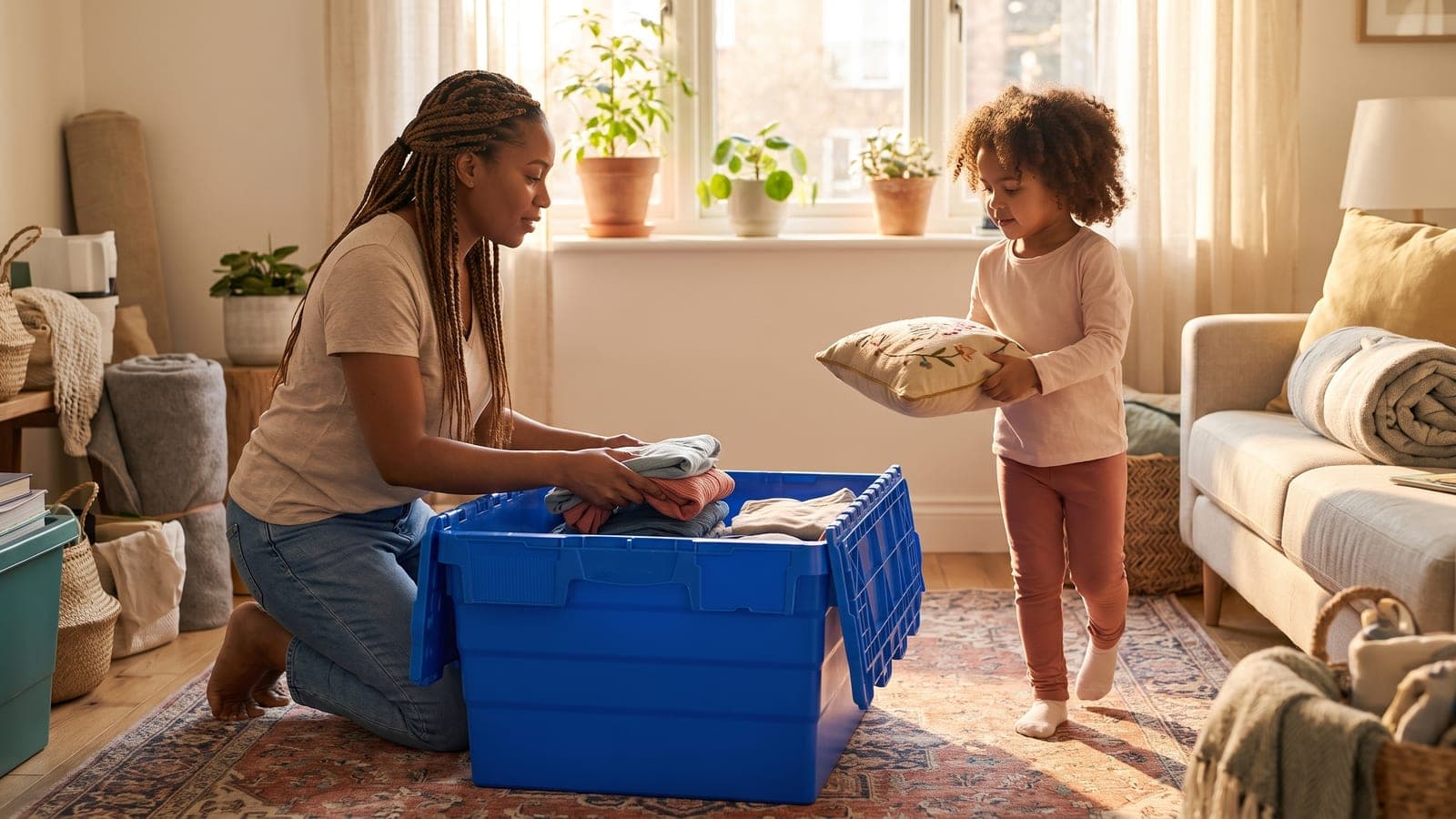
A move with children in the house is not more tiring, it is different. The logistics stay the same as ever, but a piece gets added that usually nobody plans for, because a child experiences home as the place where they know where things are and not as a container for objects.
This changes two practical things. The first is that you have to work further ahead, because you cannot pack at night for three nights in a row and get away with it. The second is that some decisions that are neutral for an adult (the order in which you take the rooms apart, where the empty cardboard ends up, when the bed disappears) are not neutral at all for a child.
What follows is a way of organising things that works, divided into stages. It is not a rigid method: adapt it to the age of your children, which is the variable that matters most of all.
First of all: how and when to tell them
Tell them early, and tell them yourself before they work it out on their own. Children notice that something is changing much earlier than we think, from the phone calls, from strangers visiting, from the tone of voice, and for them finding out by accident is worse than knowing in advance.
How to say it depends on age, but one principle always holds, which is to talk about concrete things instead of concepts. "We are moving" is an abstract piece of information, whereas "we are going to a home where you have your own room, and the school is the one next to the park where we go on Sundays" is something that can be imagined.
Under three, little is needed, because small children react to routine more than to news. Between three and six the questions are very literal: "is my bed coming?", "and the cat?", "who sleeps in my room now?". They should be taken seriously, because behind them is the real fear, which is that something will be left behind. From six upwards the social side comes into play: friends, the class, the team. There the move becomes a problem of relationships more than of objects, and it should be dealt with on that level.
One thing to avoid: selling the move as a wonderful adventure and nothing more. It works for a week, then comes the day when the child is tired, has a temperature and wants the old home, and at that point they also feel they have been tricked. Better to tell the whole truth: it will be nice, it will also be tiring, and for a while it will be strange.
Take them to see the new home, if you can
Seeing the place beforehand removes half the anxiety, because it replaces an imagined picture with a real one. If the new home cannot be visited, photos will do, or a video shot on your phone, or a walk round the neighbourhood.
If you do go, do two things. Let them into their room and ask where they would like the bed: it is a small question, but it moves the child from "I am being moved" to "I am deciding something". And take a walk outside, not just inside: where you buy bread, where the park is, which way you go to school. They will see the home anyway, whereas the neighbourhood they will not, and that is what decides whether within a month the new place will feel like home.
The boxes: let them take part, but with a limit
Children want to help, and it is right to let them, but a clear boundary is needed, because taking part and deciding are not the same thing.
It works to give each child their own box, the one for their things, and let them fill it, to get them to help put the stickers on or colour in the label, to ask them to choose which five toys travel with them instead of in the van.
It does not work, on the other hand, to sort out what to throw away together with them in the same week as the move, because a child asked to part with toys just as they are losing their home will say no to everything, and that is a reasonable reaction. If you need to lighten the load, do it before, at a neutral moment, or do it afterwards, when the new room is already theirs.
One rule that always applies: the children's room is taken apart last and put back together first. Right up to the final day it has to remain the one normal room in the house, the one where everything is still in its place while the rest is in boxes. It is worth keeping it intact even at the cost of working less efficiently elsewhere.
The box that does not travel in the van
Prepare for each child a bag or a box that you keep with you, in the car, and that does not go in the load. What goes inside:
- pyjamas and a full change of clothes
- toothbrush, the shower gel from home, the bathroom things they recognise by smell
- the soft toy or comfort object for sleeping, which must not go into a sealed box for any reason
- two or three toys chosen by them
- a book, or whatever you read in the evening
- snacks, water, wipes
- any medicines
The comfort object deserves a line of its own, because if it goes missing on the evening of the move the night that follows becomes impossible. If you have any doubt about where it is, stop and find it before loading the van, since looking for it at eleven at night among forty boxes is an experience you do not want to have.
Moving day
The first thing to decide is whether the children will be in the house that day or not.
If you can leave them with grandparents, with friends or at nursery for the day, do it, and it is not a way of shirking responsibility: a home with the doors open, corners exposed, the trolley going back and forth and people carrying heavy loads is not a place where a small child can be without someone watching them full time, and that someone, on that day, is needed elsewhere.
If instead they stay, organise the day like this:
A base room. Choose a room, in the old home and then in the new one, that stays closed and full of their things. Nothing gets loaded from in there, and it is where you go when the confusion becomes too much.
One adult assigned. You need one person who has that job and nothing else, because taking turns does not work: at the moment it really matters both of you are under a chest of drawers.
Children's timings, not moving timings. Lunch at lunchtime, nap at nap time. Skipping meals because "we will finish loading and then eat" produces a meltdown around five in the afternoon, which is exactly when you still need an hour of clear thinking.
Watch out for new hazards. Homes in the middle of a move are temporarily dangerous: doors wedged open, sockets exposed, cutters left wherever, furniture unstable because it is half dismantled. The knives for opening tape go in your pocket, not on the windowsill.
As for cardboard, there is a practical point you only see when you have children around the house, because the cardboard piles up, and the boxes left open and caved in, leaning in a half-circle in the corridor with the tape dangling, become an obstacle course precisely in the days when the children are wandering round the house more restless than usual. With rented boxes this problem shrinks, because there is no "assembly" stage and at the end of the move there is no mountain to dispose of: the Cangubox stack closed and stand up on their own, which in a narrow corridor counts for a lot.
The new bedroom, the first evening
The golden rule is that the first room you set up in the new home is theirs: before the kitchen, before your own bedroom, before anything else.
The bed assembled, the usual sheets (not the new ones bought for the occasion: the usual ones), the lamp, the soft toy, two or three toys out of the box. The room does not need to be finished, it just has to be recognisable in the dark.
The rest of the house can stay a building site for days, and that is perfectly fine. But if on the evening of the move the child has a bed that feels like theirs, in a room that has something familiar about it, you have solved the most delicate part of the whole move.
If you can, recreate the layout of the old room: bed in relation to the window, lamp on the same side, posters in the same relative position. The new room does not always allow it, but where it can be done it is a real help, especially for the youngest, who find their way around in their sleep out of motor habit.
The days after: what to expect
Allow for a few strange weeks. More fragile sleep, waking in the night, requests for help with things they used to do on their own, tantrums over trivial matters. Small children may also slip back on something that seemed settled. It is a normal reaction to a big change, and in most cases it settles down on its own.
What really helps is routine: same times, same evening habits, same people doing the same things. The content of the day has already changed completely, so if the structure changes too there is nothing left to hold on to.
It also helps not to strip the new home of references to the past. The drawing that hung in the kitchen goes back up in the kitchen. The photos come out straight away, not "when we have sorted things out". And if there is an ugly but much-loved piece of furniture, this is not the month to replace it.
On the social side, arrange an afternoon with a friend from the old home early on, if the distance allows, and one with someone from the new place, because when a child sees that old friends do not disappear they make new ones much more easily.
If they are changing school
If the move means a change of school, the timing matters. Changing in September is almost always simpler than mid-year: they start together with everyone else, at a moment when the groups are forming anyway.
If instead it happens during the school year, talk to the teacher before the first day. A teacher who has been told in advance can do small, effective things that cannot be arranged from outside: assign a desk partner, explain to the class that someone new is arriving.
And ask the school office what is needed for enrolment, a little in advance. Documents, certificates, forms: these are procedures that take days, and they are exactly the kind of thing you remember the night before.
The summary in five points
- Tell them early, in concrete terms, and take them to see the place if you can.
- Their room is taken apart last and put back together first.
- Prepare a bag that travels with you, with the comfort object inside.
- On moving day: a base room, one dedicated adult, normal mealtimes.
- In the days after, keep the routine even if the house is a building site.
The rest (the boxes, the van, the assembly) is the same move you would do anyway, just with a few more days of lead time and the care not to touch the children's room until the very end.