Leggi questa guida in italiano
Driving a rental van on a car licence: what changes compared with a car
A category B licence covers you up to 3500 kg fully loaded. What to read on the registration document, what to check while parked, and how driving changes.
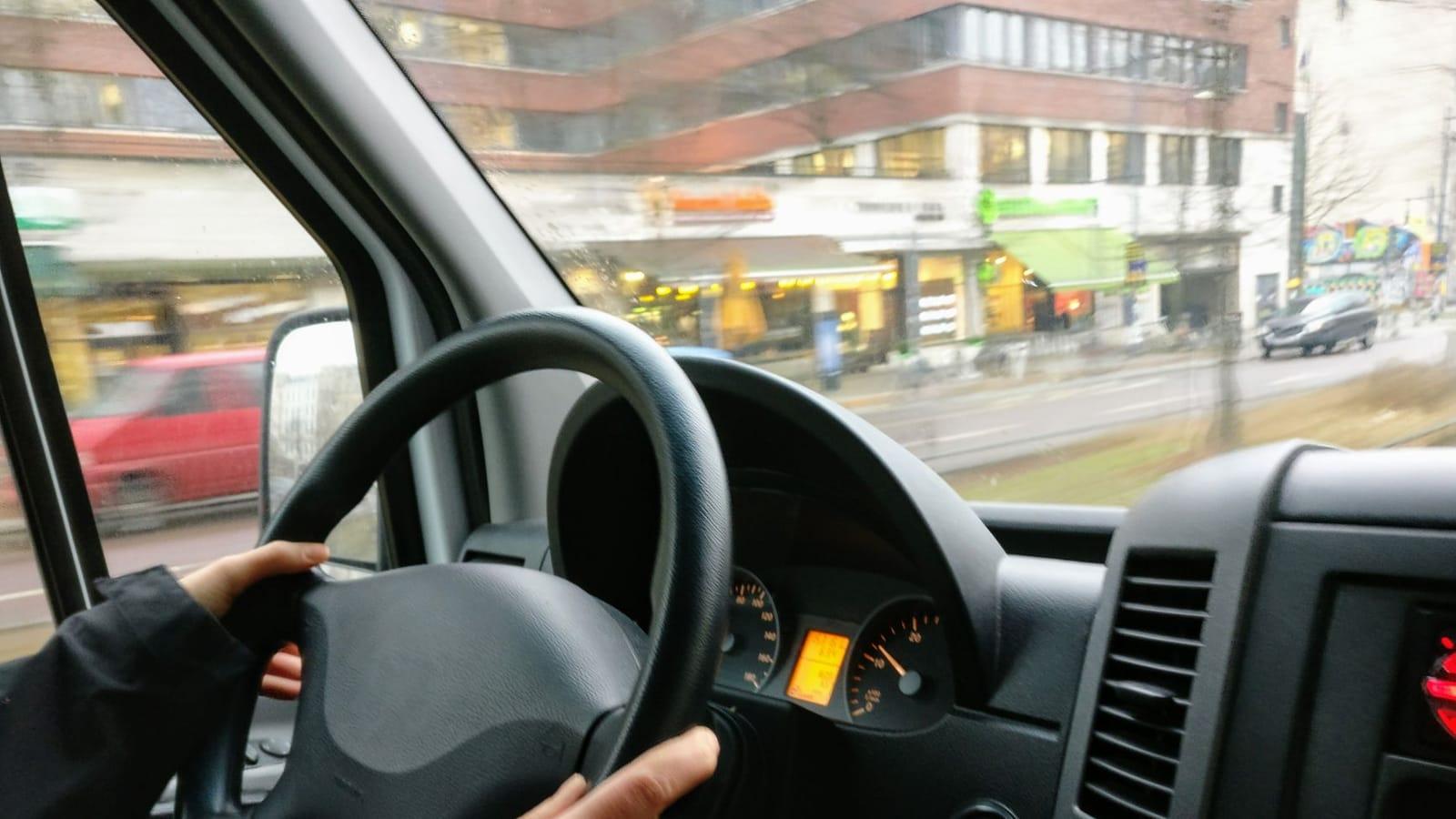
You have booked the van for Saturday and you were told a category B licence (patente B) is enough. That is true. But the first time you sit behind the wheel is the morning of the move, with a home to empty and your friends waiting on the pavement. The mirror in the middle of the windscreen shows you nothing, you cannot see the bonnet, and behind your back there is a closed cargo area that your car has never had.
Driving a van is not hard. It differs from a car in a few specific ways, and it is worth knowing them while the van is still parked, before you turn the key.
What a category B licence covers, and where to read it on the registration document
The Italian Highway Code (Codice della Strada), in article 116, says that a category B licence lets you drive motor vehicles with a maximum authorised mass of no more than 3500 kg. That number is not the weight of the empty van: it is the weight of the van with the load, the fuel and the people inside. A van you can rent on a category B licence meets that limit on paper, and on the road it meets it only if you do not load it beyond what the registration document says.
The second number is on the registration document (carta di circolazione), and it is the gross weight of that vehicle. Article 167 forbids going over it. Take away the weight of the empty van and what is left is the payload: the kilos you can really carry. Ask the rental company for it when you book, because it changes from one model to another, and remember that the people sitting in the cab count too. We read the Highway Code articles quoted on this page on the ACI website on 11 November 2026.
Then there are the rental company's own conditions, which are not law and change from one company to another: minimum age, how long you have held your licence, deposit. Read them before you book, not at the desk on collection day.
Ten minutes parked, before you set off
When they hand you the keys, do these things with the van still in the yard.
- Photograph the bodywork. Every side, the bumpers, the mirrors. The marks that are already there must appear on the handover report.
- Read the excess. The contract says how much you pay if there is damage and which parts of the vehicle the cover leaves out. Look closely at what it says about the roof and the upper part of the cargo area.
- Ask for the height of the van and write it on a slip of paper stuck to the dashboard. In a car you never think about it. With a van, a car park barrier, an underpass, a low balcony or a branch become obstacles, and the sign with the maximum height has to be read every time.
- Adjust the seat and the side mirrors. The cargo area is closed, so the two outside mirrors are your only view of what is behind you. Set them so that in each one you see the side of the van and the lane next to it.
On the road: bends, braking and reversing
Three things change compared with a car.
Bends. The van is longer than a car, and the rear wheels follow a tighter line than the front ones. If you turn as tightly as you usually do, the side of the van climbs the kerb or touches the bollard. Start steering later than feels natural and watch the mirror on the side you are turning towards.
Braking. A loaded van needs more road to stop than the same van empty. Keep a longer gap than you keep in a car and brake earlier, gently: a sudden stop reaches the load too.
Reversing. You cannot see behind you. Ask one person to get out, put them where you can see them in the mirror, lower the window and agree the signals first: come on, slowly, stop. If you lose sight of them, you stop.
In Milan there is one more thing. Area B and Area C look at the class of the vehicle, not at your licence: ask the rental company whether that van can enter where you need to go. And the space in front of the building needs thinking about early, because the permit to stop the van takes time.
The load must not move
Article 164 of the Code requires the load to be arranged so that it does not fall and does not compromise the stability of the vehicle. In a moving van the second part is the one that matters. Every time you brake, the load is pushed towards the cab, and in every bend towards one side. Whatever is not blocked shifts, and you feel a shifting load in the steering wheel.
This is why a van is loaded in sections, with the weight low down and the gaps closed. With boxes of different sizes, gaps open up between one stack and the next, and each one has to be filled. A Cangubox measures 60 × 40 × 36 cm, and there is only one size. The product sheet says they stack even when closed and loaded. So every stack has the same base, rises in equal steps and lines up with the others in regular rows. The declared load capacity is 30 kg per box, and that ceiling helps when you add up the kilos going into the van. The kit section lists everything a rental includes.
If the kilos do not add up, or if you do not feel at ease at the wheel of a vehicle like this, there are companies that do the transport only: they drive and carry, you pack the boxes in the weeks before.
When you book, ask for three numbers: the payload, the height and the excess. And on collection day drive once round the block with the van empty, before you load the first box.